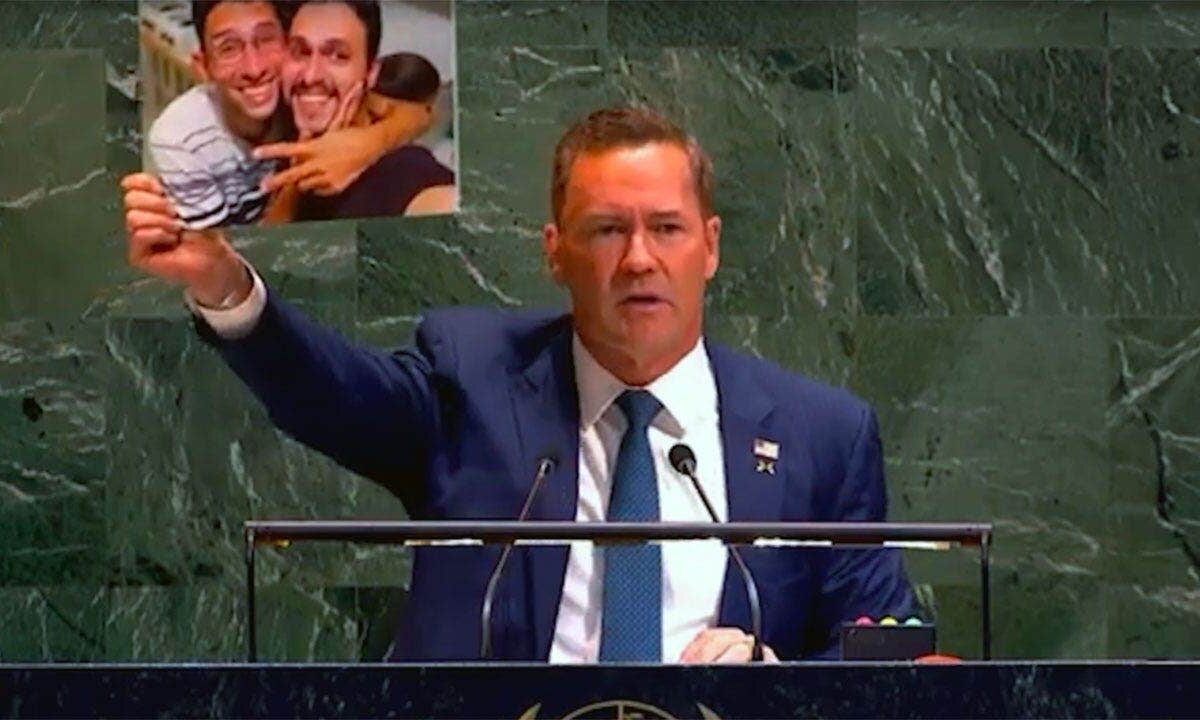
Mike Waltz UN speech at the U.N. General Assembly opened with a direct rebuttal to Havana’s accusation that U.S. policies amounted to a naval blockade, as the island struggled with a sweeping electrical collapse that officials say left nearly 10 million people without power (Reuters). Waltz framed his address around the human consequences of the outage and the treatment of dissidents (Fox News).
What Mike Waltz UN speech said at the U.N.
On the dais, U.S. Ambassador Mike Waltz displayed photographs and read names of jailed artists and activists, including Luis Manuel Otero Alcántara, Maykel Castillo Pérez and Duannis Dabel León Taboada, to underscore his claim that Cuban authorities were repressing nonviolent critics (Fox News). He told the Cuban delegation: “There is no ring of Navy warships, U.S. Navy warships sitting around this island blocking trade or humanitarian aid going into Cuba. It’s fake. It’s false. It’s a lie. Period.” (Fox News)
Waltz also directly challenged Cuba’s portrayal of the power failures as externally imposed, accusing Havana of using the blackout to deflect from mismanagement and domestic repression. During the exchange, a Cuban delegate banged on the table; Waltz answered, “This is not Havana. This is the United States of America. This is the United Nations, and we will speak, we will be heard, and we will not be silenced like your own people.” (Fox News)
Cuba blackout: scope and timeline
The U.N. confrontation took place a day after Cuba’s national electrical grid collapsed, an outage Reuters reported as affecting nearly 10 million people nationwide (Reuters). Cuban authorities described partial restorations in parts of central provinces and about one-third of Havana by the following morning, while large areas remained without stable power (Reuters).
Officials and analysts pointed to an aging grid, maintenance shortfalls and fuel delivery problems as vulnerabilities that have produced repeated failures; Reuters noted this was the third nationwide failure this year and at least the eighth since October 2025 (Reuters). Those recurrent collapses have increased the urgency of the humanitarian conversation at the U.N. (Reuters)
Disputed claims: blockade, GAESA and aid
Cuban Foreign Minister Bruno Rodríguez presented U.S. restrictions on certain fuel deliveries as tantamount to “an act of war,” arguing those measures precipitated the energy collapse. That charge was a central point of his intervention at the U.N. (Fox News).
Waltz rejected the blockade allegation and urged focus on Havana’s policy choices and economic governance. He cited U.S. government figures describing GAESA, the military-run conglomerate, as controlling a large portion of the economy and referenced an $18 billion assets figure attributed in U.S. statements (Fox News). Reuters and other analysts have reported varying estimates of GAESA’s economic footprint (roughly 40% to 70%), and Reuters notes that the $18 billion figure is disputed by Cuban officials and outside analysts due to limited public data and differing methodologies (Reuters).
The competing numbers illustrate how diplomatic arguments rely on contested statistics: Washington points to a specific asset estimate and corporate influence as evidence of mismanagement and militarized control, while Havana rejects those figures as inaccurate or politically motivated (Fox News; Reuters).
Waltz also catalogued incoming humanitarian shipments from multiple countries and international organizations and said the United States had provided over $100 million in assistance this year, plus sizable commodity programs cited for prior years — statements attributed to his remarks at the U.N. (Fox News).
Humanitarian and political context
Both delegations tied the blackout to broader political and humanitarian disputes. U.S. representatives and some independent organizations linked the crisis to government failures in maintenance, fuel management and infrastructure investment (Fox News; Reuters).
Estimates of political prisoners were raised during the debate. Human Rights Watch reported in April that more than 700 people remained imprisoned for political reasons, while Prisoners Defenders put the count above 1,200 in spring 2026; Cuban authorities reject the label and dispute the counts (Human Rights Watch; Prisoners Defenders). These differing tallies featured prominently in Waltz’s reading of names and in Havana’s rebuttals (Fox News).
At the U.N., U.S. officials also noted the cost of reopening the agenda item for debate; one delegate highlighted an estimated $84,000 procedural cost and argued the funds could instead support emergency supplies such as food, medical kits and solar lanterns for affected families (Fox News).
Source attribution and next steps
This coverage is grounded in live reporting and transcripts of the U.N. exchange (Fox News) and contemporaneous reporting on the grid failures and timeline (Reuters). Where claims about the blackout’s scale and the grid’s failure history appear, those details reflect Reuters’ reporting; where quotes, the reading of jailed artists’ names and the immediate U.S. rebuttal are described, they derive from Fox News coverage of the session (Fox News; Reuters).
Observers should watch for independent technical assessments of the grid failures, further transparency on GAESA’s finances, and the arrival and distribution of international aid to verify competing claims. The diplomatic messaging at the U.N. is likely to continue as both sides press narratives that serve domestic and international audiences (Fox News; Reuters).
Source links: Fox News; Reuters.
Frequently asked questions
Did Mike Waltz say the US imposed a naval blockade on Cuba?
No. In his U.N. remarks, Mike Waltz UN speech rejected Cuba’s claim of a naval blockade, saying there was “no ring of Navy warships” blocking trade or humanitarian aid; that blockade allegation was voiced by Cuba’s foreign minister (Fox News).
How many people were affected by the Cuba blackout?
Reporting cited by Reuters indicated the grid collapse left nearly 10 million people without power; officials reported partial restorations to some regions, including parts of central Cuba and about one-third of Havana (Reuters).
What is GAESA and why is its asset figure disputed?
GAESA is Cuba’s military-run conglomerate. U.S. statements cited an $18 billion assets figure; Reuters and other analysts have produced a range of estimates for GAESA’s share of the economy and note the $18 billion figure is disputed by Cuban officials due to limited public data and differing methodologies (Reuters).