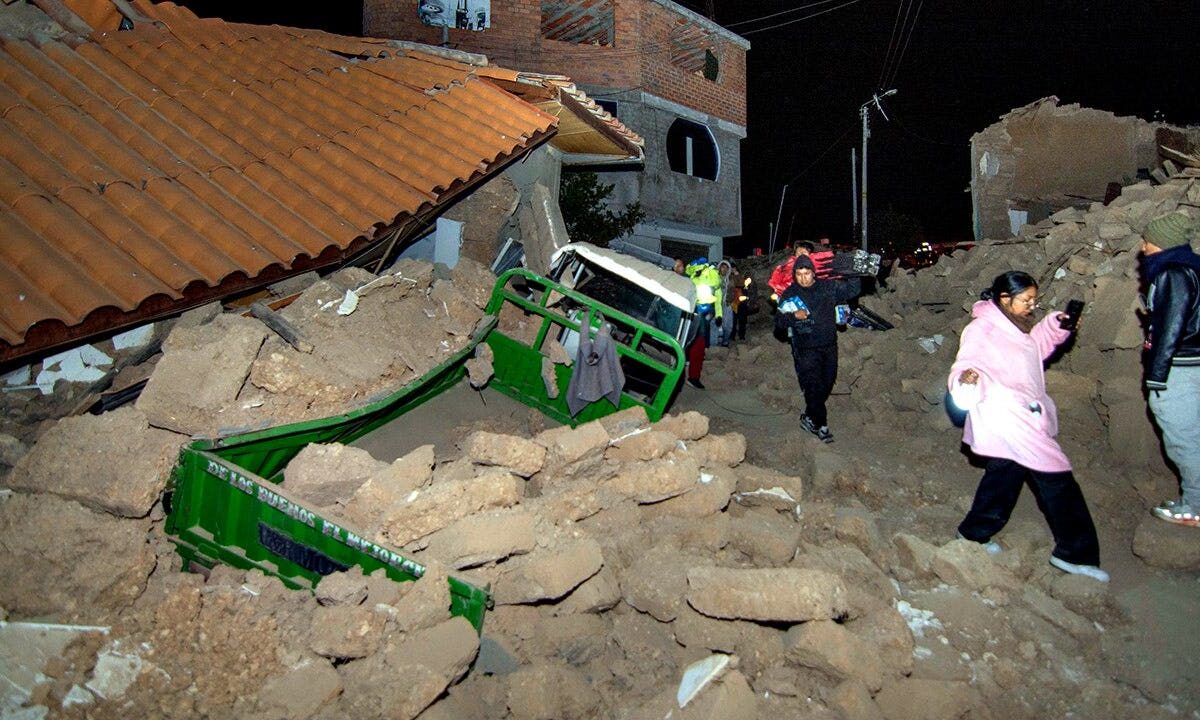
A Peru earthquake measuring magnitude 5.5 struck near the town of Sicaya shortly after 9:20 p.m. local time Saturday, shaking central Andean communities and leaving at least five people dead and hundreds displaced, the U.S. Geological Survey and Peru’s civil defense agency said.
Details of the Peru earthquake
The U.S. Geological Survey (USGS) recorded the quake at magnitude 5.5 and located it near Sicaya in the Junín region. The tremor began just after 9:20 p.m., according to the USGS catalog of recent seismic events.
Peru’s National Civil Defense Institute (INDECI) reported early figures showing more than 20 injured and at least 300 people forced from their homes because buildings were damaged or deemed unsafe. INDECI officials stressed those counts are provisional and subject to change as search teams complete canvassing of affected areas.
Local emergency teams began rapid assessments to identify collapsed structures, unsafe dwellings and priority needs for shelter and medical care. Several community buildings, including a church and a convent in nearby towns, were reported seriously damaged and unusable.
Human toll in Sicaya and Chongo Bajo
Authorities said the quake killed at least five people, though officials cautioned that those totals were preliminary and could be revised as rescue teams reach harder-hit pockets. INDECI emphasized the numbers for missing or unaccounted-for residents remain provisional while verification continues.
Field reports and images from Chongo Bajo showed families wrapped in blankets outside cracked houses and neighbors searching through rubble for belongings. Smaller communities such as Huayucachi also reported structural damage and residents moving to relatives’ homes or community shelters.
A resident told a local radio station she was trying to find shelter with her children and said, “My home has been destroyed,” reflecting the immediate displacement many families now face.
Why adobe buildings worsened damage
Officials and local engineers pointed to the widespread use of traditional adobe construction as a key reason damage and fatalities were concentrated in small rural settlements. Adobe — sun-dried mud brick commonly used in Andean homes — performs poorly under seismic shaking unless reinforced with modern techniques.
Local civil defense officials noted many older houses lack structural reinforcements like steel ties or improved masonry, which increases the risk of collapse even in moderate quakes. That vulnerability helps explain why a 5.5 magnitude event could produce disproportionate harm in communities with a high prevalence of unreinforced adobe houses.
Authorities reiterated the long-term challenge of retrofitting and replacing unsafe housing across remote Andean districts, where resources and access to technical assistance are limited.
Response, missing people and safety steps
INDECI has mobilized personnel to coordinate search-and-rescue efforts, damage assessments and delivery of emergency aid. Regional health and municipal teams are working with community leaders to set up temporary shelters, distribute blankets and provide basic medical assistance to the injured.
Officials warned that the number of missing or unaccounted-for people remains uncertain and is being refined as teams reach outlying homes and hamlets. INDECI described the missing-person figures as provisional and subject to revision as verification continues.
Authorities urged residents to avoid entering damaged buildings, to shut off gas and electricity if they suspect leaks, and to register at designated shelters so officials can prioritize help. People should follow instructions from local emergency broadcasters and municipal authorities regarding evacuation routes and aid distribution.
Context: seismic risk in the Andes
Peru lies along the Pacific Ring of Fire, a region of frequent earthquakes and volcanic activity. The Andean highlands have a history of deadly quakes, and experts say the combination of seismic hazards and vulnerable housing creates a persistent risk for rural communities.
Officials and seismologists frequently cite the 2007 Pisco earthquake — a magnitude 7.9 event that killed nearly 600 people and destroyed large parts of the coastal city of Pisco — as a reminder of how destructive powerful quakes can be in Peru. While Saturday’s event was smaller in magnitude, the human toll underscores how construction types and local preparedness affect outcomes.
What comes next
Rescue and recovery operations will continue into the coming days as teams complete damage assessments and search for anyone still unaccounted for. INDECI has said data on casualties, injuries and displaced people will be updated as field reports are consolidated.
Longer term, officials say priorities will include restoring safe shelter for displaced families, evaluating infrastructure and accelerating programs to reinforce or replace unreinforced adobe housing in high-risk zones.
This report draws on data from the U.S. Geological Survey and Peru’s National Civil Defense Institute (INDECI). The original field reporting and images were first published by Fox News: Earthquake shakes Peru’s Andes region, killing at least 5, displacing hundreds.