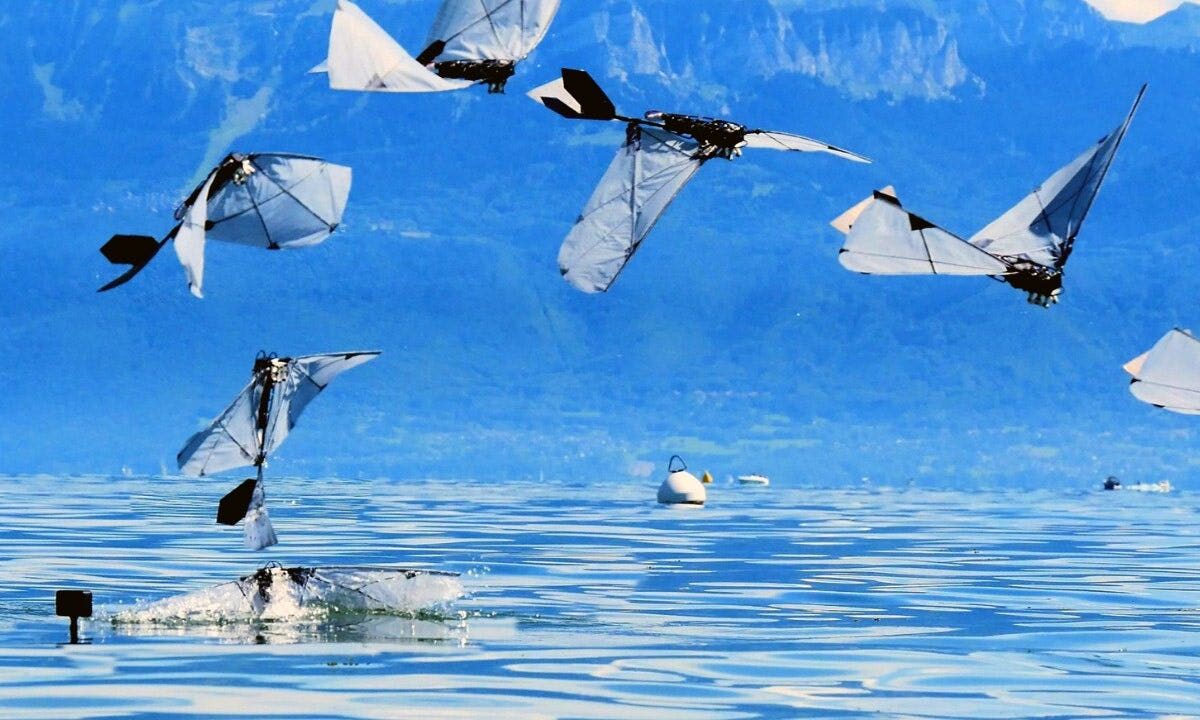
What the robotic bird can do
Researchers at MIT and the Swiss Federal Institute of Technology Lausanne (EPFL) built an 8.8-ounce robotic bird that flies, dives into fresh water, swims and then relaunches into the air using the same flexible wings. Published in the journal Science and summarized in a Fox News report, the prototype demonstrates a single wingset that handles both aerial and underwater propulsion and retakes flight without swapping propulsion modes.
The platform costs roughly $300 in parts, uses commercially available components and ships open CAD files so teams with a 3D printer can reproduce or adapt the design. The work highlights the mechanical trade-offs involved in operating across air and water but also makes the design accessible for follow-on experiments.
How the robotic bird’s flapping wings work in air and water
The core mechanical idea is a single, flexible wingset that changes shape passively as it moves between air and water. In air the robot can reach flapping frequencies up to about 11 times per second; underwater the effective flapping rate used in tests ranged from roughly 0.1 to 6 times per second to accommodate the much higher fluid resistance.
Flexible wing materials bend under fluid loads — in some trials the structure compressed substantially, shortening the effective stroke and reducing torque demands on the motor. That passive compliance helps prevent motor stall when the wings suddenly meet denser water and reduces peak power draw during the water-entry phase.
Investigators evaluated swimming and flying performance with reference to the Strouhal number, a dimensionless quantity that links flapping frequency, stroke amplitude and forward speed. Both the robotic bird and comparable diving birds operate in Strouhal ranges commonly associated with efficient flapping propulsion (near roughly 0.2–0.4). The team also tuned the hull and internal mass distribution so the prototype is approximately neutrally buoyant—neither strongly rising nor sinking while submerged—so the robot doesn’t waste energy constantly fighting buoyancy during underwater phases.
Key tests, limits and risks
Most experiments were conducted in controlled fresh-water pools and lab tanks. Engineers reported the system can complete a water-to-air transition in under one second; typical relaunch sequences used eight to ten wingbeats after breaking the surface. Successful launches depended on a careful balance of wing stiffness, tail placement and exit angle, with an exit angle near 70 degrees producing the strongest relaunches in the lab setting.
Important limitations remain. Tests relied on human control for critical segments such as timing the exit and initiating particular maneuvers; some repetitive sequences used timers or simple triggers, but full onboard autonomy for decision-making and closed-loop control has not yet been demonstrated. The team explicitly notes that saltwater durability is untested: reported trials were in fresh water and additional corrosion protection and materials qualification will be required before any saltwater deployment.
The low material cost—roughly $300—lowers the barrier for replication and academic experimentation, but prototype affordability does not eliminate operational risks in the field, including weather, debris, biofouling and the need for robust waterproofing and corrosion resistance for long-term use.
Why this matters for environmental monitoring
Combining flapping flight with underwater propulsion in a single, low-cost platform creates practical options for environmental monitoring. A small robotic bird could fly from shore or a boat to a target area, dive to collect short-duration measurements or samples, then return to the air to transmit data or relocate. The lack of exposed high-speed propellers can reduce entanglement and may be quieter around wildlife than typical rotors.
Because the researchers released open CAD files and relied on off-the-shelf parts, universities, citizen scientists and small engineering groups with a 3D printer can reproduce or adapt the design. That transparency accelerates iteration on sensors, autonomy modules and environmental hardening—provided teams follow ethical and regulatory norms for field tests.
What comes next
Next steps are clear: add closed-loop sensors and control for autonomous transitions, extend battery life or energy density for longer missions, and validate durability in rough, debris-filled and saltwater conditions. Field trials beyond the lab pool will be essential to quantify real-world performance and maintenance needs.
Researchers and early adopters should avoid overstating current capabilities: the prototype demonstrates a mechanical possibility and a low-cost path to replication, but it is not yet a fully autonomous or saltwater-ready device suitable for unmonitored deployments.
Source attribution
This summary draws on the Fox News technology report on the project and the team’s peer-reviewed publication in the journal Science. Fox News summarized the study and included links to the research notes and the project’s released open CAD files: https://www.foxnews.com/tech/robot-bird-swims-underwater-flies-away. The authors’ work appears in Science; the Science journal entry for the paper is available via the journal’s website (Science.org) and is linked from the Fox News summary.
Notes: experiments cited in this article were performed in fresh water; saltwater testing and full onboard autonomy have not been demonstrated in the published tests. Open CAD files were published by the research team and are linked from the Fox News story referenced above.