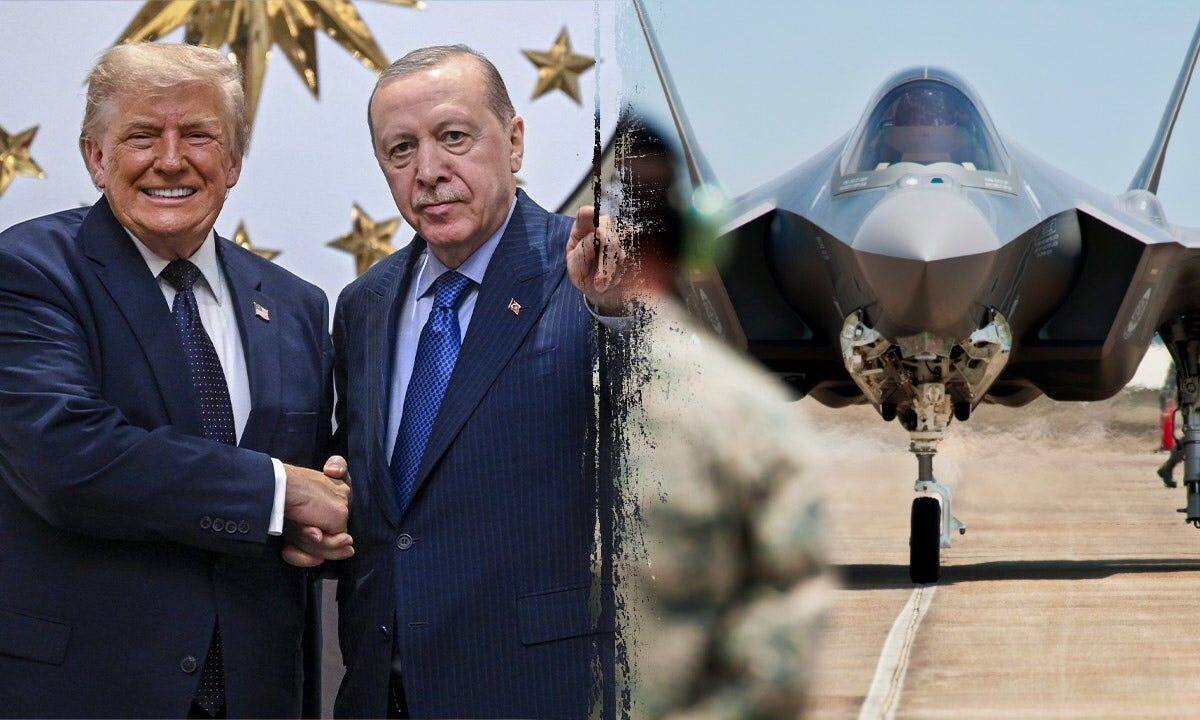
President Donald Trump announced at the NATO summit in Ankara that he plans to lift U.S. sanctions on Turkey and signaled he is prepared to move forward with the long-stalled F-35 sale to Turkey. Speaking alongside President Recep Tayyip Erdoğan, Trump said the White House was “going to be taking the sanctions off,” describing the step as part of restoring defense ties with a NATO ally.
The comments are the clearest public indication to date that the White House is considering reversing steps taken after Turkey acquired a Russian S-400 air-defense system. Fox News first reported the president’s remarks and the administration’s openness to resuming the sale, a move that immediately raised questions about statutory barriers, congressional resistance and national security risks tied to the F-35 program (Fox News).
Trump announcement at NATO summit
At the bilateral meeting in Ankara, Trump framed the policy change as part of broader alliance management, saying the U.S. should not be sanctioning friends. He spoke publicly next to Erdoğan, signaling a diplomatic thaw after months of outreach from the White House.
According to Fox News reporting, Trump indicated the administration would remove sanctions imposed on Turkey’s defense sector and that he was open to authorizing transfers of F-35 stealth fighters that had been halted after Ankara’s S-400 purchase (Fox News). The president’s on-the-record comments set off immediate debate in Washington about whether the administration can lawfully carry out such a transfer without further steps.
What the F-35 sale to Turkey means for NATO
A restored F-35 relationship would be a major diplomatic shift within NATO. Turkey hosts strategic bases and commands one of the alliance’s largest militaries, giving Ankara outsized importance for operations across the eastern Mediterranean and the Middle East. Restoring F-35 access could improve bilateral interoperability with Turkey, but it would also require reassurance to other NATO members.
Allies wary of Ankara’s closer ties with Moscow — and its acquisition of the S-400 — would likely press for safeguards. Fox News coverage notes the announcement will require diplomatic work across the alliance to manage trust, operational planning and technical interoperability challenges (Fox News).
Legal and congressional hurdles
Even if the White House supports a sale, statutory obstacles remain. Congress enacted sanctions under the Countering America’s Adversaries Through Sanctions Act (CAATSA), and lawmakers later added specific language in the fiscal year 2020 National Defense Authorization Act (NDAA) — Section 1245 — that directly limits F-35 transfers after Turkey’s S-400 purchase.
Section 1245 of the FY2020 NDAA bars transfer of F-35 aircraft to Turkey unless the administration certifies that Ankara has satisfied statutory requirements related to the Russian missile system. Fox News reports that the certification required by Section 1245 is a high legal bar and that moving forward without it could be viewed as a violation of U.S. law (Fox News).
Congressional opposition has been bipartisan. Fox News notes that House and Senate members have publicly urged the president not to proceed, warning a sale would undermine national security and conflict with statutes enacted after Turkey’s S-400 acquisition (Fox News). Lawmakers have tools ranging from new legislation to appropriations language and oversight hearings to block or delay a transfer.
Security concerns over the S-400
The Pentagon has long warned that Russia’s S-400 surface-to-air missile system includes sensors and radar that could collect technical data on the F-35’s radar signature and electronic emissions. Officials say that data, if obtained and analyzed by adversaries, could reduce the F-35’s stealth advantages.
When Turkey was removed from the F-35 program in 2019, the White House said the F-35 “cannot coexist with a Russian intelligence collection platform that will be used to learn about its advanced capabilities.” Pentagon acquisition officials, including then-acquisition chief Ellen Lord, warned that operating both systems in proximity could jeopardize the program’s security — an assessment summarized in the Fox News reporting (Fox News).
What comes next: certification, White House decisions and congressional pushback
If the administration seeks to proceed, several steps are likely and would unfold over weeks to months rather than days:
- Certification: The administration would need to address Section 1245’s requirements in a formal certification or seek legislative relief. Fox News reports the certification threshold is legally significant and would need to be documented (Fox News).
- White House policy change: A decision to lift CAATSA-related sanctions would involve Treasury and the White House, including potential coordination with the Department of Defense.
- Pentagon security reviews: The Defense Department would need to complete technical security assessments and interoperability certifications for any renewed transfers.
- Congressional response: Lawmakers could pursue legislation, attach restrictions to appropriations, hold hearings, or use other oversight powers to block or condition a sale.
Aside: even if the White House signals support, a practical sale would still require certification and potentially further congressional action. That means restoring access to F-35s is neither immediate nor guaranteed, and would require negotiation on both legal and technical fronts.
Why it matters
Restoring F-35 sales to Turkey would affect NATO interoperability, U.S. technology protection and regional power dynamics. For the Pentagon and many lawmakers, the core concern is protecting the F-35’s stealth advantage while managing alliance cohesion. For Turkey, regaining access would be a notable diplomatic win; for the U.S., it would trigger a complex mix of legal, technical and political decisions.
FAQ
Will the U.S. lift sanctions on Turkey and deliver F-35s?
President Trump said he plans to lift sanctions, according to Fox News reporting. But lifting sanctions and delivering F-35s are separate steps. A transfer would require satisfying Section 1245’s certification requirement, completing Pentagon security reviews, and likely negotiating with Congress (Fox News).
Can Congress block an F-35 sale under current law?
Yes. Section 1245 and CAATSA create legal obstacles, and Congress can also use appropriations and oversight to prevent or delay a transfer. Bipartisan opposition has already been publicly signaled, as reported by Fox News (Fox News).
How does Turkey’s S-400 affect F-35 security?
The Pentagon’s assessment, reiterated in public statements and covered by Fox News, is that the S-400’s radar could collect data on the F-35’s radar signature and electronic profile, potentially degrading the aircraft’s stealth advantage if that data were exploited (Fox News).
Source: Reporting summarized from Fox News: Fox News.