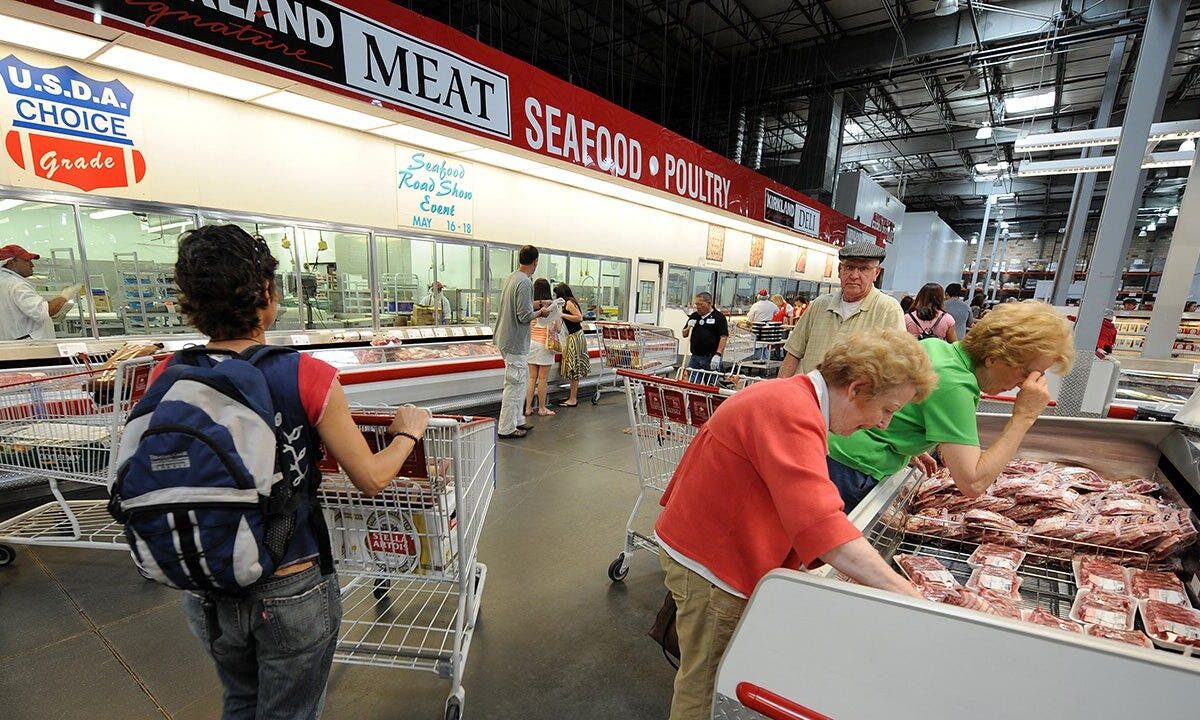
Costco tops the list for many higher-income Americans as their primary grocery store, a new YouGov snapshot shows. The survey found 11% of respondents earning at least $150,000 a year named Costco as the place they do most of their grocery shopping.
Survey snapshot: who named Costco their main store
The YouGov survey asked U.S. adults where they do most of their grocery shopping and then reported results by income group. Among respondents in households earning $150,000 or more, 11% said Costco was their main grocery store. YouGov defines higher-income as households with at least $150,000 in annual income — roughly more than 200% of the U.S. median household income, by the firm’s account.
The snapshot separates results into income bands so readers can see how preferences shift across spending power. YouGov reports these as weighted estimates from its online panel; subgroup estimates can carry greater uncertainty when sample sizes are small, and readers should consult YouGov’s methodology for full sampling and margin-of-error details.
How grocery spending differs by income
The survey highlighted a clear spending divide. Just over 51% of higher-income households reported spending more than $150 each week on groceries. By contrast, only about 28% of middle- and lower-income households said they spend more than $150 weekly.
That spending gap matters because it changes which price structures and pack sizes make economic sense. Households that regularly spend more can move through larger packages faster, meaning the higher up-front cost of bulk purchases is offset by lower unit prices over time.
Why Costco appeals to higher-income shoppers
Food industry analyst Phil Lempert told Fox News Digital the result is consistent with patterns the industry has tracked for years: household makeup and shopping frequency influence store choice.
“Wealthier households typically are larger households. So it fits perfectly with the model of Costco having larger sizes. Also, wealthier people shop more often, and what they want is value.” — Phil Lempert
Lempert and the survey point to three linked factors behind Costco’s appeal: bulk buying, stronger per-unit value and the tradeoff of an annual membership for ongoing savings. Costco’s standard membership ranges from $65 to $130 a year, and for many shoppers who purchase in volume that fee can be recovered in a few trips via lower per-unit prices.
Analysts caution this is an interpretation of observed patterns rather than proof of direct causation. Lempert frames the explanation as industry-informed analysis: larger households and higher weekly spend make bulk packs and warehouse pricing models more attractive. Local availability, store proximity and product mix also affect individual decisions.
Where rivals fit: Walmart, Kroger and others
The survey places other chains differently across income groups. Among middle- and lower-income Americans, Walmart Supercenter was the most commonly named go-to, with roughly 20% naming it as their primary store. Kroger and “other” tied at about 10% for that group. By comparison, only about 5% of middle- and lower-income respondents chose Costco as their primary grocery store.
Walmart’s combination of low prices, wide store footprint and one-stop shopping often wins among shoppers for whom travel time and convenience matter most. Kroger’s share reflects its large supermarket footprint and regional strengths in many markets, which can keep it competitive with warehouse clubs for certain shoppers.
Practical tips from the analyst for smart grocery buys
Lempert offered concise, practical advice for shoppers seeking to lower costs while keeping convenience. His tips favor simple, frugal habits that work whether you shop warehouse clubs or neighborhood stores.
- No. 1, always shop with a list. Planning reduces impulse buys and helps avoid wasted food.
- Compare unit prices, not just sticker prices, to see where bulk purchases truly save money.
- Buy only what you can reasonably consume or store before it spoils; freeze portions to extend shelf life.
- Consider frozen alternatives for seafood or specialty items; frozen options can match fresh quality at lower cost.
- Use online ordering and curbside pickup when it reduces travel time and helps you stick to planned items.
Why it matters
Understanding where different income groups shop helps retailers and policymakers gauge how price structure, store format and membership models affect household budgets. For shoppers, it clarifies that higher up-front spending (membership fees or bulk buys) can be a net saving if households consume the larger quantities those formats provide.
Key takeaways
- 11% of households earning $150,000+ named Costco as their main grocery store.
- 51% of higher-income households report spending more than $150 weekly on groceries versus 28% of middle- and lower-income households.
- Costco’s bulk pricing and membership model aligns with larger households and higher weekly spending.
- Walmart remains the top pick for many middle- and lower-income shoppers due to convenience and low sticker prices.
Source attribution
This article is based on reporting and data from Fox News and YouGov. See the original Fox News story for the analyst interview and context: Wealthy Americans choose one grocery store chain over rivals, survey finds (Fox News). The survey data and subgroup definitions are available from YouGov: YouGov – Grocery habits of higher-income Americans. YouGov reports that results come from its online panel and are weighted; subgroup estimates may have greater sampling uncertainty, and readers should consult YouGov’s methodology page for details on sample sizes and margin-of-error information.