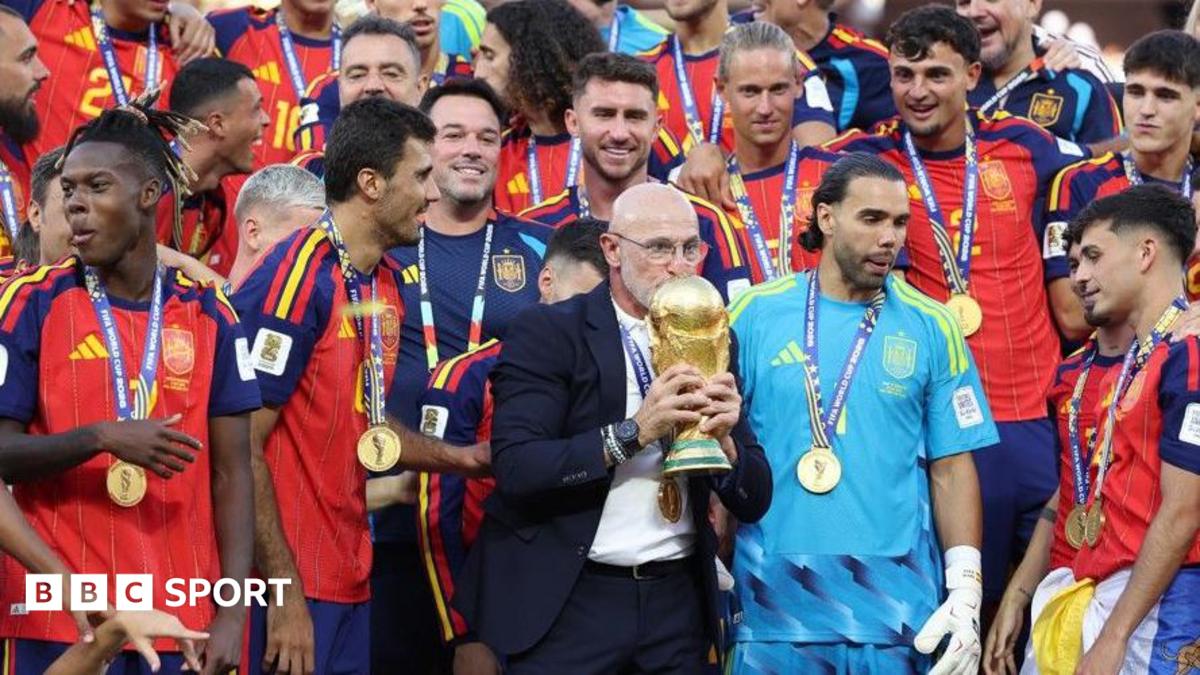
Spain’s recent run — sixteen titles in five years — has reshaped the conversation about international football. According to BBC Sport, Spain’s national teams accumulated that total; BBC Sport also reported Spain was the first nation to hold both the men’s and women’s World Cups at the same time. That particular milestone is reported by BBC Sport and is presented here with that attribution, while noting that how different outlets count tournaments and titles can vary.
This analysis looks beyond the headline figures to examine why the results have followed, focusing on development systems, coaching pipelines, tactical continuity and the likely consequences for rivals and markets.
Spain record: sixteen titles in five years
The scale matters because the wins span senior tournaments, youth competitions and continental events, suggesting depth rather than a single exceptional tournament run. BBC Sport’s summary provides the central counting that underpins the sixteen-titles figure; that reporting frames the rest of this piece.
Seen together, the results point to consistent outcomes across age groups and both the men’s and women’s programmes rather than isolated success by one squad.
How Spain develops players and coaches
At the base of Spain’s sustained output is a dense network of club and regional academies that emphasise technique and decision-making from an early age. Youth work focuses on ball control, small-sided play and pattern-based repetition so players arrive at senior levels with a shared technical foundation.
Coaching development has been a parallel strand. A deliberate coach-education pipeline — where youth coaches, club staff and national team coaches share curriculums and priorities — reduces transition friction as players move between levels. That consistency helps maintain a common playing language across cohorts.
Federation initiatives and competition structures that give young players meaningful match minutes also play a role. Regular, competitive minutes in age-group tournaments and reserve football mean that tactical concepts tested in youth setups are battle-hardened before players reach senior squads.
Because the emphasis is on transferable skills and on a coaching culture that rewards technical excellence, players are typically comfortable adapting to different tactical demands as they progress. That adaptability is important across club and international calendars.
Tactics and style that carry across teams
A possession-oriented approach, paired with positional discipline and quick transitional triggers, is the tactical backbone seen repeatedly across Spanish squads. The goal is control of key zones rather than possession for its own sake: possession is used to manage tempo and create high-probability chances.
Coaches across men’s, women’s and youth teams use similar frameworks: shared pressing triggers, build-up patterns from the back and midfield roles that emphasise movement between lines. These shared frameworks mean players developed in one setting can more readily translate their game into another.
Importantly, coaches have adapted the core style to suit the physical and situational strengths of each squad. Adaptation rather than blind replication has allowed Spain to remain effective against varied international opponents and across tournament contexts.
By the numbers: titles, records and recent form
Putting the central figures in a compact table helps show how the headline total relates to on-field structures and outcomes.
| Measure | Recent figure or note |
|---|---|
| Titles (five-year span) | Sixteen titles in five years (reported by BBC Sport) |
| World Cups | Men’s and women’s World Cup champions simultaneously (as reported by BBC Sport) |
| Cross-team continuity | Shared tactical principles across men, women and youth teams |
| Development output | Dense academy-to-pro pathways and coordinated coaching development |
Data note: the counts and framing in this piece use BBC Sport reporting as the primary contemporary summary of Spain’s run; other outlets or governing bodies may use different inclusion rules for trophies and youth competitions.
Why this matters for international football
Spain’s model shows how long-term investment in coaching and youth structures can convert into repeated success. That will prompt federations to re-evaluate where resources are targeted — not just towards short-term results but towards coach education, scouting networks and match opportunities for young players.
At club level, demand for players trained in Spanish technical systems can shift recruitment and development priorities. Clubs that value technical comfort and positional intelligence may prioritise signings from Spanish-trained players or hire coaches with experience in those environments.
Competitively, rivals must now plan for pipelines rather than single-tournament tactics. Nations with ambitions to contest consistently at the top level will look for durable means of replenishing squads, not only temporary tactical fixes.
FAQ
What happened with Spain? BBC Sport reported that Spain’s national teams accumulated sixteen titles over five years and that Spain held both the men’s and women’s World Cups at the same time. That summary is the basis for the core claim here, presented with that attribution.
Why does Spain matter? The breadth of results — across genders and age groups — suggests system-level strengths. Those strengths make Spain a case study for federations and clubs thinking about long-term development and coach education.
What happens next? Expect more scrutiny of Spain’s development pathways and coaching approaches, and potential emulation in scouting, recruitment and coach hires globally. Tactical elements that are easily teachable and transferable are most likely to spread.
Source and credits
Main reporting and the title-count summary: BBC Sport — Sixteen titles in five years – why Spain are a dominant force. This article uses BBC Sport as its primary source for the headline figures and attribution of the World Cup milestone.