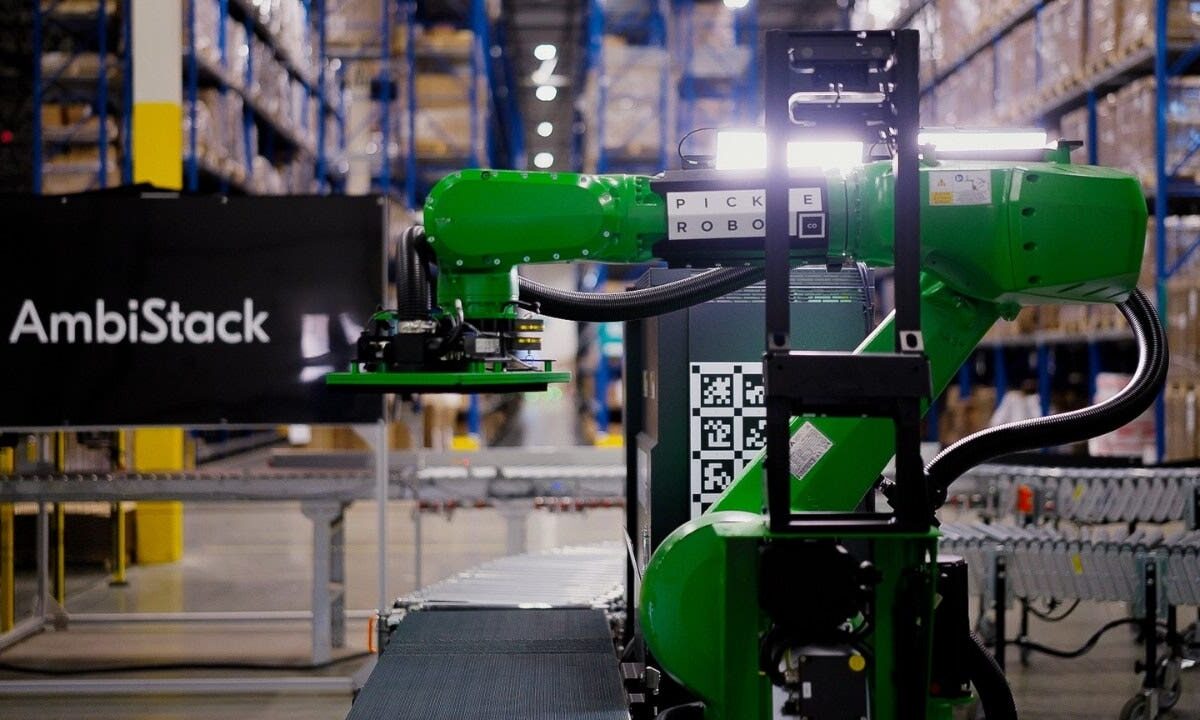
Ambi Robotics and Pickle Robot Company announced a commercial integration that links Pickle Robot’s trailer-unloading robots with Ambi Robotics’ AmbiStack pallet-building system. The vendors say the connected flow lets warehouse robots hand packages from an unloading system into a downstream scanning-and-stacking cell without a constant human transfer, addressing a long-standing dock-side handoff problem.
What happened
The two companies publicly revealed a joint, commercial integration that ties Pickle Robot’s trailer-unloading hardware to AmbiStack’s scanning-and-stacking pallet cell. According to reporting in Fox News, the move is positioned as an operational bridge between trailer-unloading and pallet-building tasks using warehouse robots.
Warehouse robots: how the integration works
The integrated flow begins at the trailer. Pickle Robot’s system removes mixed freight from trailers or containers and places cases onto a transport conveyor. That conveyor moves packages into the AmbiStack cell, where cases are scanned and their dimensions or label data are read.
AmbiStack then plans stacking patterns and places cases to create stable pallet builds. In practice the vendors say coordination requires tuning conveyor speeds, scan timing and robot motion so the unloading robot and stacking cell operate as a single, timed sequence rather than two isolated machines.
Software, sensors and control logic manage timing and exceptions. The vendors describe the approach as an example of Physical AI: models and control systems that translate perception into real-time motion decisions to handle physical variation such as dented boxes, misoriented labels or mixed-size SKUs.
Why operators care and what vendors claim
Vendors and operators point to three potential benefits: fewer manual handoffs, reduced strain on dock workers, and a smoother inbound flow that can cut processing time between trailer arrival and storage or outbound shipping.
Ambi Robotics framed the initiative as interoperability. “Warehouse operators shouldn’t have to choose between best-in-class technologies and seamless integration,” said Jim Liefer, CEO of Ambi Robotics.
AJ Meyer, founder and CEO of Pickle Robot Company, told reporters that customers want automation that “improves real-world throughput while fitting into existing operations.” Both companies emphasized that field performance will vary by facility and workload mix.
Those benefits are presented as possible outcomes rather than guarantees. The vendors say the system can work with existing conveyors and dock layouts, but compatibility depends on specifics such as conveyor geometry, dock footprint and the variety of package sizes a facility handles.
Other limits to watch for include exception handling: jams, unreadable labels or unstable pallets still require human intervention. The design aims to reduce repetitive lifting, but it does not eliminate the need for trained staff to manage edge cases and perform maintenance.
Practical checks for warehouse teams
Operators should treat the integration as a systems project and validate fit using site-level tests. Key checks include:
- Loading dock automation: Confirm conveyor geometry, available floor space and safe robot zones match vendor requirements.
- Trailer unloading: Verify Pickle Robot’s reach, supported case-size range and cycle time against typical trailer mixes.
- Pallet building: Test AmbiStack’s stacking patterns for your SKU mix and evaluate pallet stability under realistic loads.
- Throughput measurement: Run timed trials that mirror peak-shift mixes, not only single-case or idealized tests.
- Exception workflow: Define escalation paths and staffing for jams, unreadable labels and damaged freight.
- Labor impact: Assess retraining needs for staff shifting from full-time unloading to monitoring and exception handling.
Conducting these practical checks helps operators validate vendor throughput and safety claims before signing a commercial deployment agreement.
Source attribution and vendor quotes
The integration was reported by Fox News. The original report includes vendor comments and outlines the technical flow from trailers into AmbiStack: Warehouse robots move packages without human handoff — Fox News.
Key vendor statements from the reporting include Jim Liefer of Ambi Robotics: “Warehouse operators shouldn’t have to choose between best-in-class technologies and seamless integration.”
AJ Meyer of Pickle Robot Company said: “Customers want automation that improves real-world throughput while fitting into existing operations.”
The Fox News story frames the integration as an example of connecting specialized robotics to reduce manual transfer points at the loading dock. The companies’ performance claims reported in that article have not been independently validated.
What comes next
Early commercial deployments and trials will show whether linked systems meet throughput promises at scale and how often human oversight is needed for exceptions. Operators planning trials should measure throughput, downtime for jams and labor hours shifted from lifting to monitoring.
FAQ
How do warehouse robots handle trailer unloading and pallet building?
One system unloads mixed freight from trailers onto a conveyor; that conveyor feeds cases into a stacking cell where the pallet-building robot scans and places cases. Software and sensors coordinate timing so the flow resembles a single continuous process.
Will this integration reduce warehouse jobs or change roles?
Automation can reduce repetitive, physically demanding tasks, but staff remain necessary for exception handling, equipment maintenance and system monitoring. Companies should plan retraining and role changes rather than assume wholesale job loss.
Can the system work with existing conveyors and loading dock setups?
Vendors say the integration can fit many existing facilities, but compatibility depends on conveyor geometry, dock layout and case mixes. On-site compatibility tests and throughput trials are essential before a full deployment.
Source: Fox News — Warehouse robots move packages without human handoff.