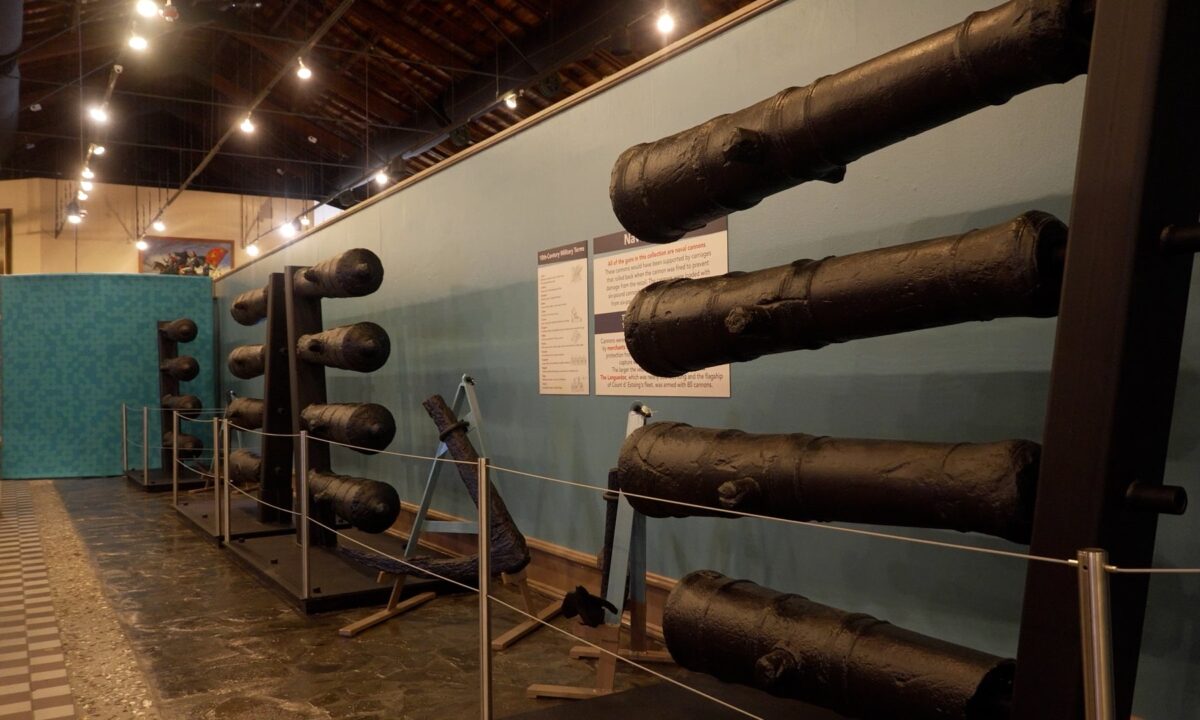
Nineteen Revolutionary War cannons recovered from the Savannah River after nearly 240 years underwater are now on display at the Savannah History Museum in Savannah, Georgia. The group of iron guns — some still containing cannonballs and remnants of powder charges — was raised after being discovered by a U.S. Army Corps of Engineers crew dredging the river in 2021.
The find was announced as part of the museum’s new exhibit timed for America 250 commemorations. Conservators and historians say the weapons offer a rare, tangible window into naval and local Revolutionary War history, even as some interpretive claims about the discovery are being examined by researchers.
Revolutionary War cannons found in Savannah River
Officials say the 19 guns spent nearly 240 years underwater before dredgers with the U.S. Army Corps of Engineers uncovered them while clearing a channel for modern shipping in 2021 (U.S. Army Corps of Engineers). Teams recovered the cannons and a dozen or so small artifacts from the site where fragments of concretion and marine growth adhered to the iron.
Several of the guns were discovered still packed with shot and what conservators identified as remnants of gunpowder charges. Those on-site finds helped researchers place the group in the Revolutionary-era maritime environment around Savannah, though exact vessel associations and depositional circumstances are still under study.
How the cannons were recovered and preserved
After initial recovery, most of the guns were sent to a conservation laboratory at Texas A&M University for cleaning and stabilization. Conservators described heavy concretion — layers of encrusted shell and mineral deposits — that had to be removed carefully to protect any original surface detail (Texas A&M University).
Restoration work involved electrochemical desalination: conservators run gentle electrical currents through a water bath to leach salts from the iron, a process that stabilizes the metal for display on land. Final treatments included controlled chemical cleaning, protective coatings and waxing to slow further corrosion.
Seventeen of the cannons were fully restored; two were intentionally left unrestored so visitors can compare treated and untreated examples side by side. That contrast is part of the exhibit’s conservation story and helps illustrate both the fragility and survivability of marine archaeological materials.
What historians say — and the limits of interpretation
Curators and local historians place the guns in the context of the 1779 siege known as the Battle of Savannah. Reporting and historical accounts note the battle produced more than 800 casualties in a brief, intense engagement; those casualty figures reflect the conventional historical record for the 1779 action.
Nora Fleming Lee, CEO of the Coastal Heritage Society, framed the discovery as archaeologically significant and suggested the cannons may have been scuttled to block French movement upriver. She is quoted by museum officials and the Coastal Heritage Society in describing the group as, in her words, “the largest discovery of 18th century artillery from a single Revolutionary War naval event.” The Coastal Heritage Society (CHS) has shared commentary as part of the museum unveiling (Coastal Heritage Society).
Those statements are presented as interpretations by museum and society officials. Independent verification of the “largest discovery” claim and the exact circumstances of sinking — whether deliberate scuttling, loss during battle, or other causes — remain areas for further research. Responsible reporting treats such assertions as scholarly hypotheses rather than settled facts; ongoing study by conservators, maritime archaeologists and archival historians aims to clarify the assemblage’s provenance.
On display at the Savannah History Museum
All 19 cannons are part of the Savannah History Museum’s new exhibit, “Loyalists & Liberty: Savannah in the American Revolution,” which opens during America 250 commemorations. Museum staff say the guns help connect visitors to the naval and material history of the period. The unrestored examples are deliberately displayed next to restored pieces so visitors can see the conservation process and better understand the science that makes long-term display possible.
The exhibit frames objects within broader narratives and personal perspectives intended to broaden public understanding of the Revolution in Savannah. Visitors seeking details on hours, tickets or guided tours should consult the Savannah History Museum’s official site for the latest visitor information (chsgeorgia.org).
Source attribution and what comes next
The initial reporting on the discovery and museum unveiling appeared in Fox News, which documented the recovery, conservation work at Texas A&M and commentary from the Coastal Heritage Society and museum officials. For additional institutional information, see the U.S. Army Corps of Engineers, the Coastal Heritage Society and Texas A&M University pages linked above.
Curators and conservation scientists say additional study of small artifacts recovered with the guns, material analysis and archival research will continue. Those efforts aim to better date individual pieces, confirm vessel associations and clarify the tactical circumstances that led to the guns’ presence in the river.
Future work may include further metallurgical testing, comparative analysis with other Revolutionary War artillery finds and publication of conservation reports in peer-reviewed venues. For now, the display offers the public access to a rare assemblage and invites more scholarly inquiry; readers should view interpretive claims about scale or intentional scuttling as preliminary until peer-reviewed analyses and detailed excavation reports are published.
FAQ
What happened with Revolutionary War cannons?
A dredging crew from the U.S. Army Corps of Engineers discovered 19 cannons in the Savannah River in 2021. They were recovered, conserved at a Texas A&M lab and placed on permanent display at the Savannah History Museum.
Why does Revolutionary War cannons matter?
The cannons are tangible artifacts that illuminate naval and local Revolutionary War history, offer evidence for maritime actions around Savannah, and let visitors see conservation science at work. They also provide material evidence that can inform archival research and battlefield interpretation when combined with continuing study.
What happens next?
Museum staff and conservators plan continued study of the artifacts, publication of conservation findings and archival research to refine the historical interpretation of the find. Independent researchers may conduct further analysis to test claims about the assemblage’s size, origin and purpose.
Source: Fox News — Revolutionary War cannons debut at Savannah History Museum for America 250. Additional context and institutional information provided by the Savannah History Museum, the Coastal Heritage Society and Texas A&M University.