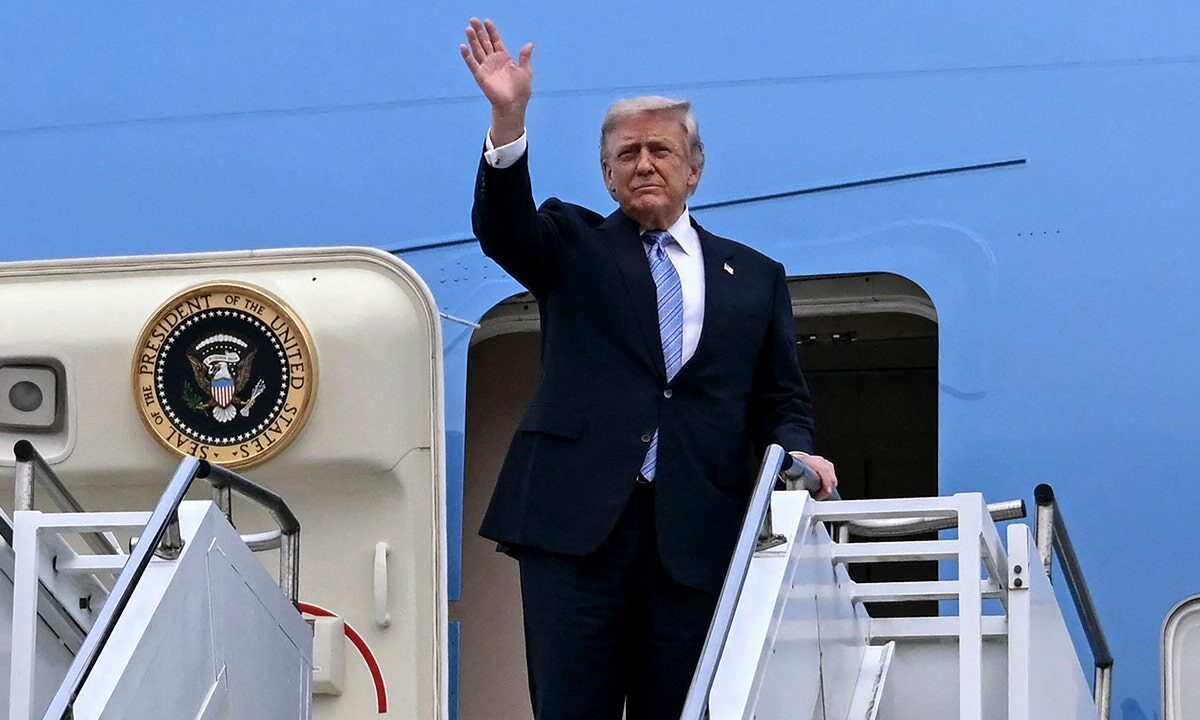
President Donald Trump said at the NATO summit that he believes Iran wants him dead, and reporting that Israel shared intelligence about a purported plot has put the Trump Iran assassination threat at the center of questions about an unusual midtrip Air Force One aircraft swap. The Wall Street Journal reported the intelligence sharing as an unconfirmed allegation, and U.S. officials have not publicly verified that those reports prompted operational decisions.
Trump Iran assassination threat: What Trump said at NATO
At the NATO summit in Ankara, Mr. Trump repeatedly told reporters he was “No. 1 on the kill list for Iran,” framing the claim in personal terms while linking it to broader tensions after the U.S. killing of Iranian commanders and recent maritime incidents attributed to Tehran. His comments were on the record to reporters at the summit.
How the Trump Iran assassination threat affected Air Force One choices
On the trip to Turkey, Trump flew aboard a newly refitted Boeing 747 that Qatar donated and that U.S. officials have called a temporary presidential bridge aircraft. For the first leg of the return trip from Ankara to Royal Air Force Mildenhall in the U.K., the president used a legacy VC-25A; he then returned to the Qatar-donated jet for the U.K.–U.S. leg.
The U.S. Air Force released a statement saying the accelerated conversion of the Qatar-donated aircraft deferred some high-end systems but was completed without accepting “any risk regarding security, safety, or secure communications.” Media reporting and published photos showed the donated 747 operating alongside the VC-25A; The New York Times reported the Secret Service recommended using the older VC-25A as a precaution, though the Secret Service has not publicly described the detailed rationale for the swap.
Former Secret Service special agent Bill Gage told Fox News he had “never seen a plane switch up” midtrip in his experience and suggested that if protection officials urged the move, it likely reflected a conservative, precautionary posture by the protection detail rather than a public confirmation of a specific, imminent plot.
What the intelligence reports say
The Wall Street Journal reported that Israeli intelligence officials told U.S. counterparts that Iran had developed a new plan to target Mr. Trump; the WSJ presented that account as an unconfirmed allegation and the reporting has not been independently verified in public. Intelligence sharing between allies is common, but such reporting does not equate to judicial proof, and U.S. officials routinely vet partner reporting before taking operational steps.
Observers note context from earlier developments: a 2024 Justice Department charge alleged an IRGC-linked effort to surveil and attempt to kill then‑President‑elect Trump, and past public reporting has documented exchanges of threat information between Israel and the United States. Those facts help explain why security teams take even unverified leads seriously while still seeking corroboration.
Recent U.S.-Iran hostilities and regional context
Tensions between Washington and Tehran have risen amid Iran-linked attacks on commercial shipping in the Strait of Hormuz and subsequent U.S. strikes on targets the U.S. has linked to Iranian-linked maritime operations. The pattern of strikes, counterstrikes and proxy activity in the region has produced a heightened threat environment for U.S. personnel and partners.
Analysts also point to long-standing grievances dating to the U.S. killing of Qasem Soleimani in 2020 as part of the broader background for asymmetric threats and messaging from Iran-aligned groups. Those historical events do not prove any specific new plot, but they inform how intelligence agencies and protection details evaluate risk.
Expert reaction and analysis
Security veterans cautioned that an operational decision like a midtrip aircraft swap can indicate prudence by protection officials rather than confirmation of a discrete action by an adversary. Bill Gage, speaking to Fox News, suggested the switch was likely prompted by protective concerns evaluated by the Secret Service and related agencies.
Other former officials have observed that public statements and aggressive rhetoric from Iranian hardliners can create permissive environments for violent actors, an interpretation offered as analytical context rather than evidence of a state-ordered assassination. Such expert commentary is circumstantial and does not replace formal intelligence corroboration.
What officials say
The White House has not publicly said whether the intelligence reported by the Wall Street Journal prompted the aircraft change. White House communications officials have emphasized that the newer, temporarily converted jet meets operational security requirements and that protection teams use “every tool at our disposal,” language provided in official briefings.
The U.S. Air Force has described the conversion timeline and the deferral of certain high-end systems while insisting the aircraft met necessary security and communications standards. The FBI and Secret Service declined to comment publicly on whether the reported threat information changed the operational threat level for the president.
What comes next
Investigators and protection details will continue vetting leads, seeking corroboration from multiple intelligence sources and assessing operational risk. Because details of protective measures and intelligence assessments are often withheld for security reasons, public verification of the Wall Street Journal’s account or additional official disclosures could be limited or delayed.
If U.S. agencies obtain corroborating information, that could lead to changes in visible protective postures or to classified briefings for Congress and allied partners. If the reports remain unconfirmed, the episode is likely to be cited as an example of how allied intelligence sharing and precautionary operational choices intersect in high-profile travel.
This article draws on reporting from The Wall Street Journal and The New York Times, interviews and commentary published by Fox News, public statements from the U.S. Air Force and the White House, and a 2024 Justice Department filing referenced in public reporting. Major claims about intelligence sharing are reported as unverified where applicable.