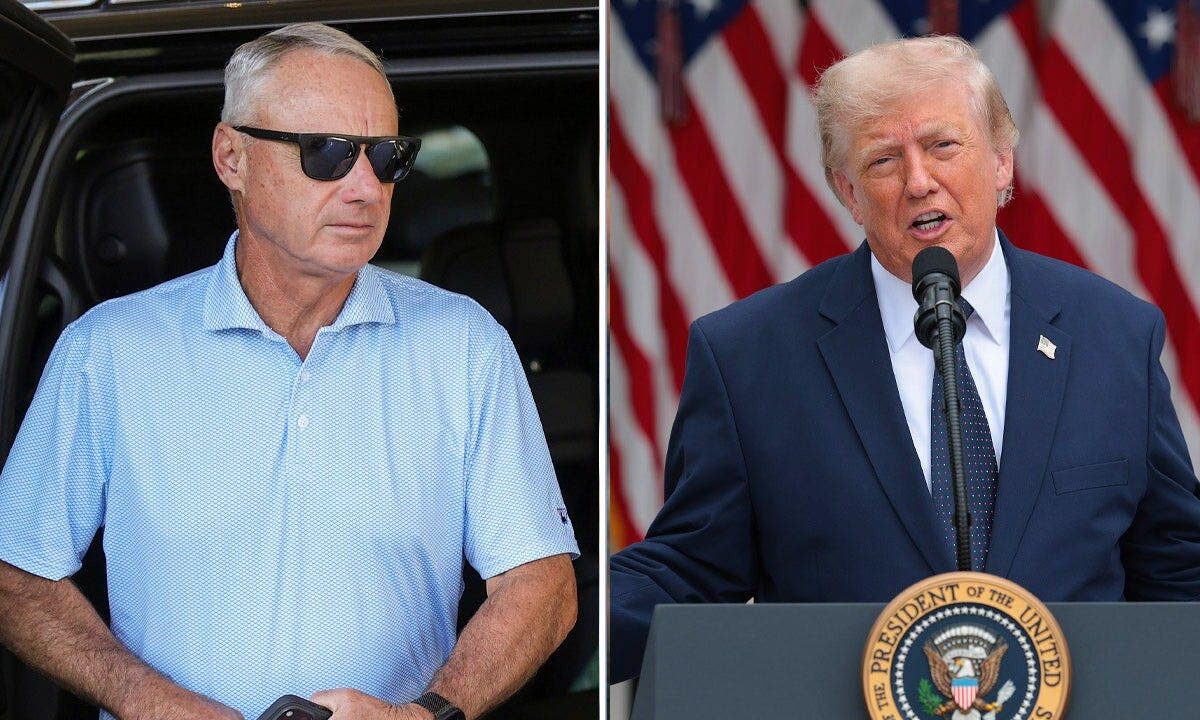
MLB CBA negotiations have become a central labor story this summer after team owners formally proposed a hard salary cap — the first written push for such a limit since the 1994 labor crisis. That proposal has sharply divided the parties and placed the collective bargaining agreement, which expires in December, squarely on a risky timetable that leaves the 2027 season in potential jeopardy. Commissioner Rob Manfred told reporters that former President Donald Trump is “interested” in the dispute but that he will “pass” on outside intervention as talks continue.
MLB CBA negotiations: Where talks stand now
Bargaining remains stalled on core financial architecture. Owners have advanced a package centered on a hard salary cap and related structural changes; the players’ union has rejected a hard cap as nonnegotiable. With the CBA set to expire in December, both sides face a constrained window to bridge differences before spring preparation for 2027 would be affected.
Negotiators have moved from exploratory conversations to more formal proposal-and-response exchanges. That shift increases public scrutiny and raises the likelihood of faster escalation if neither side shows flexibility.
Owners propose a salary cap
Owners argue a hard salary cap would promote competitive balance and help control costs for smaller-market clubs. In public filings and statements, proponents say a cap — paired with revenue sharing or other mechanisms — could create predictable payroll ceilings that limit extreme spending disparities between top and bottom clubs.
For baseball this is historic: unlike the NHL, NBA and NFL, MLB has not operated under a league-wide salary cap in modern times, and owners’ formal written proposal is the first time since 1994 that such a structural cap has surfaced in bargaining. Supporters contend that a cap could be tailored with carve-outs, thresholds or transitional rules to address concerns about player pay and to protect certain contract guarantees.
Players push back
The players’ union has signaled unified opposition to a hard cap, framing it as an existential threat to free-market salaries and long-fought collective gains. Union leaders and many agents warn that a cap would reshape contract valuation, arbitration outcomes and the financial upside available to top performers — narrowing the routes by which players earn elite salaries.
That opposition is rooted in recent labor history. The 2022 lockout, which delayed the regular season, remains a vivid memory for players and fans and informs the union’s caution. With players emphasizing preserving market-driven compensation, negotiators are likely to press alternatives — higher luxury-tax thresholds, modified revenue sharing, changes to service-time rules or arbitration mechanisms — rather than accept a hard cap.
Manfred on Trump and outside attention
At the All‑Star Game media window, Commissioner Rob Manfred addressed growing public and political attention. He confirmed that former President Donald Trump has publicly expressed interest in the dispute, referencing Trump’s remark that it is “shocking” that the league does not have a salary cap. Still, Manfred was clear about outside offers: “Behind that, I’m going to pass,” and he cautioned reporters that speculation about political intervention was “wildly, wildly inappropriate.”
Manfred’s comments suggest the commissioner’s office plans to keep negotiations within traditional labor channels despite high-profile commentary. That stance reflects practical and ethical concerns about political involvement in private labor negotiations and underscores the league’s preference for bargaining solutions over external pressure.
What comes next
The path to a deal is narrow but defined: intensified bargaining sessions, formal mediator involvement, or rapid public posturing by either side are all plausible as December approaches. The union will likely continue to press compromise options that preserve upward salary mobility — such as raising luxury-tax thresholds, reworking revenue sharing, or altering arbitration and service-time constructs — while owners may push for structural guarantees that limit payroll growth.
Commissioner Manfred warned that momentum matters — “The best way to lose momentum is to stand still” — and that warning frames the immediate risk. If talks remain frozen, the practical consequences could include a lockout or delayed season planning, which would affect players, fans and local economies tied to spring training and regular-season games.
Fans should watch for official bargaining updates, mediator announcements, and any union or ownership filings that signal a formal work action or lockout. Given the stakes, both sides have incentives to avoid a repeat of recent disruptions, but significant philosophical disagreement over a hard cap makes a negotiated compromise more difficult.
Source: Fox News reporting on the MLB CBA negotiations — original coverage: Fox News.