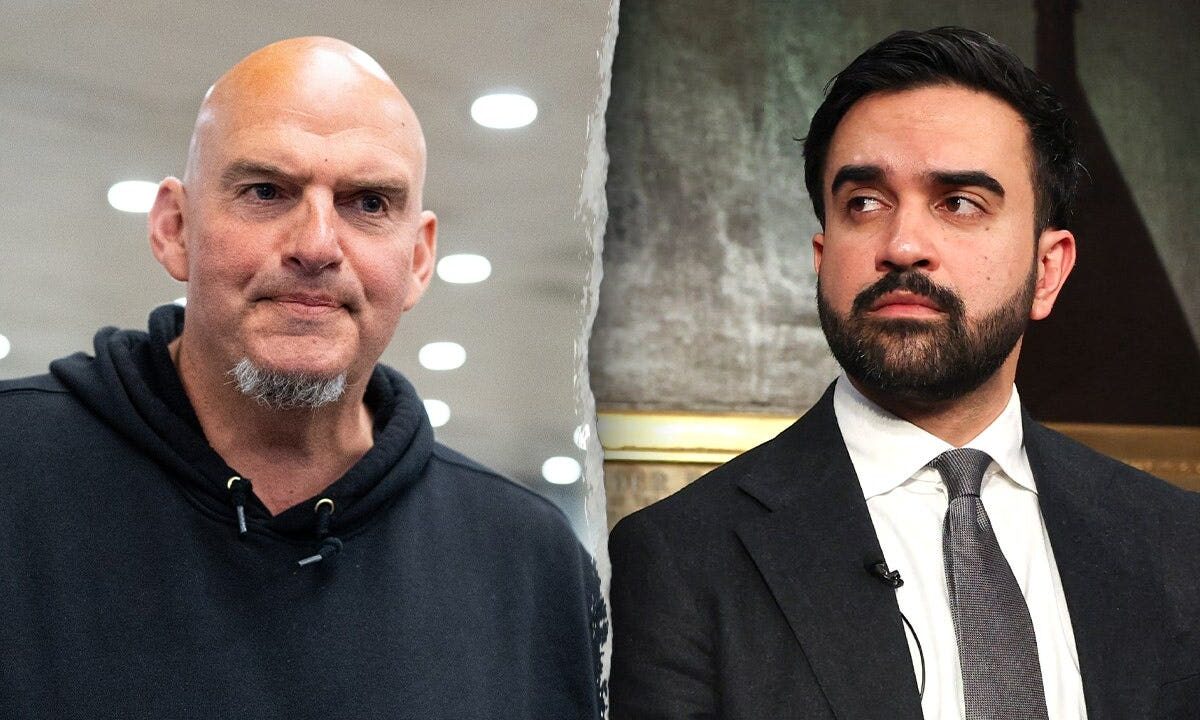
The Fetterman Mamdani Netanyahu arrest dispute widened into a sharp public clash when Sen. John Fetterman publicly rebuked New York City Mayor Zohran Mamdani after Mamdani said he would seek to detain Israeli Prime Minister Benjamin Netanyahu if the leader traveled to New York.
Fetterman Mamdani Netanyahu arrest clash
The exchange centers on Mamdani’s statements that he would pursue arrest if Netanyahu visits New York for United Nations or other events, citing a November 2024 International Criminal Court arrest warrant. Mamdani has suggested that leaders accused in the warrant “belong in The Hague,” language that frames the matter as one of international accountability; Netanyahu and his government deny the allegations tied to that warrant.
On Fox News’ “Sunday Morning Futures,” Fetterman dismissed Mamdani’s remarks as unrealistic and constitutionally problematic, calling the mayor a “clown.” “He’s just a clown to even say that, so he won’t try that,” Fetterman said, arguing the mayor lacks practical or legal authority to carry out an ICC-based arrest in New York City.
“[He’s] such a tough guy to say that kind of thing. He has no way to do that,” Fetterman said.
Legal limits on an ICC-based arrest in NYC
The legal framework sharply constrains any effort by municipal authorities to act on an ICC arrest warrant. The United States is not a party to the Rome Statute, the treaty that created the International Criminal Court, and therefore U.S. federal and local authorities are not treaty-bound to enforce ICC warrants. More practically, an ICC warrant is enforced through cooperation by states that are parties to the court; it does not itself create domestic arrest authority in a nonparty state.
Beyond treaty status, basic principles of diplomatic and sovereign immunity apply. Heads of state and certain high-level officials typically enjoy immunity from arrest in foreign jurisdictions under customary international law. That immunity is assessed and managed at the federal level, not by municipal police, and the State Department and federal courts generally play decisive roles when immunity or diplomatic status is in question.
Municipal law enforcement such as the NYPD operates under state and local laws and cannot unilaterally override federal prerogatives or international law norms. New York City’s Law Department would likely be consulted on any proposed action, but legal observers say the path to a lawful detention of a visiting foreign leader would involve federal agencies, potential litigation, and complex questions about whether any immunity exceptions might apply — hurdles that make an arrest by a city on an ICC warrant highly unlikely.
Legal experts also note that even where arrest is theoretically possible under domestic statutes, it can quickly become a matter of international diplomacy and litigation, with courts potentially asked to issue rulings on immunity or jurisdiction before any physical detention could proceed.
Political fallout inside the Democratic Party
The dispute has reverberated through Democratic politics, exposing tensions between more centrist voices and the party’s progressive wing. Fetterman’s forceful criticism framed the matter as a broader test of Democratic alignment on Israel and foreign policy. “That would force me to kind of reevaluate should I remain as a Democrat,” Fetterman said, linking the controversy to what he described as a troubling shift in party rhetoric — mentioning commentators like Hasan Piker as emblematic of that shift.
Mamdani, a self-described democratic socialist, has presented his remarks as accountability-driven, arguing that leaders accused in the ICC warrant should face justice. Supporters in the party’s progressive flank have praised the focus on international justice, while centrists and pro-Israel Democrats have reacted sharply, portraying Mamdani’s comments as politically inflammatory and impractical.
The clash raises immediate political calculus: for Fetterman and similar figures, distancing from what they see as extreme rhetoric is a way to reassure moderate voters; for Mamdani and allies, forceful language on accountability boosts visibility and energizes activists. The dispute is likely to shape messaging and endorsement dynamics as 2026 primary and general election debates intensify.
What happens next
Immediate steps are likely to be legal and political rather than operational. Mamdani’s team has said it is exploring whether the city has any legal authority to act and has consulted with the Law Department. Even if municipal attorneys identify a possible avenue, federal agencies — including the State Department and potentially the Justice Department — would be central to any real-world resolution, especially because questions of immunity and diplomatic status would arise.
Practically, several scenarios are more probable than an actual arrest: legal memoranda and internal reviews by city counsel; public statements or symbolic measures by the mayor’s office; federal officials clarifying policy or discouraging unilateral city action; and, if pursued, preemptive litigation where courts would be asked to rule on immunity and jurisdiction. Any attempt to detain a foreign head of government would almost certainly prompt immediate intervention from federal authorities and could provoke diplomatic repercussions.
Fox News Digital sought comment from Mamdani’s office and other parties; as of publication neither the mayor’s office nor the senator’s team provided further clarification. Netanyahu’s office has denied the allegations in the ICC matter and continues to contest the court’s findings. For now, the clash looks set to remain a political flashpoint that tests how local officials engage with international legal developments.
Why it matters
The episode matters because it juxtaposes international criminal processes with the limits of municipal power and the fault lines of domestic politics. It is a reminder that global legal instruments can become catalysts for local political conflict, and that mayors who invoke international mechanisms can quickly set off national debates about legality, diplomacy and party unity.
Source: Fox News