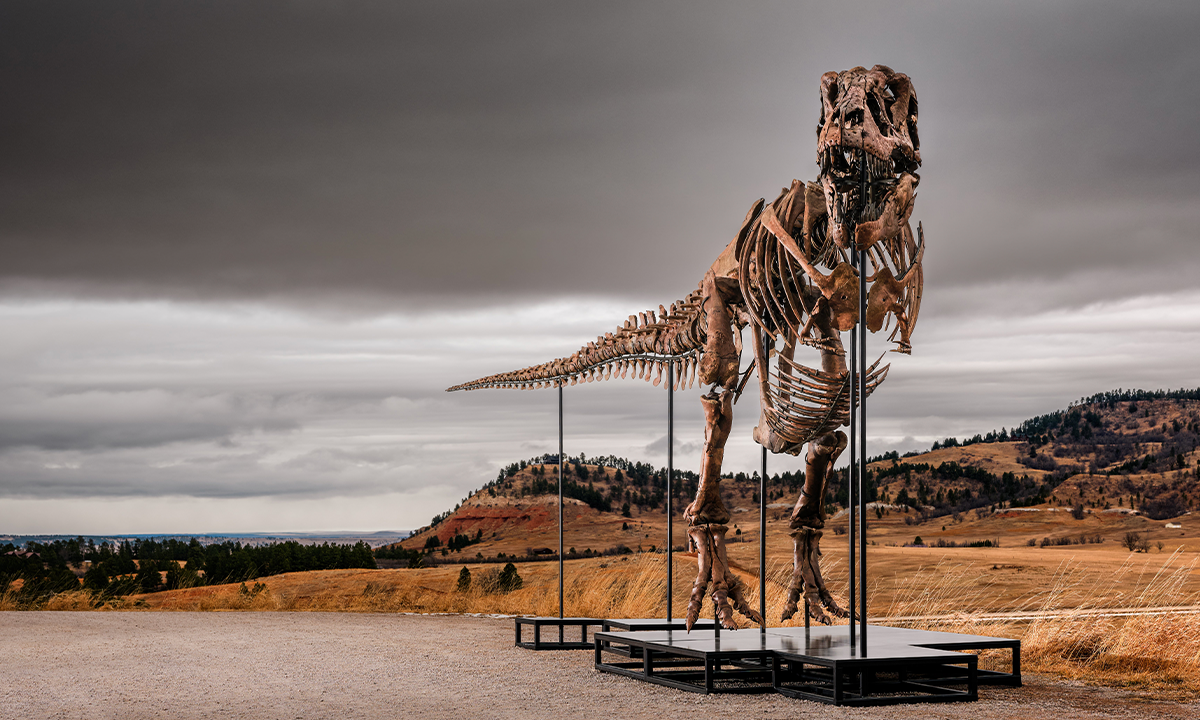
The Gus T. rex fossil sale ended Tuesday with the specimen fetching $50.1 million at Sotheby’s in New York, far above the $20 million-to-$30 million pre-sale estimate. The winning bidder took part by phone and chose to remain anonymous, Sotheby’s said.
In a roughly 10-minute auction that drew several bidders, the near-complete Tyrannosaurus rex skeleton known as “Gus” became one of the priciest fossils sold at auction and renewed debate over whether top specimens belong in public museums or private collections.
Gus T. rex fossil sale: quick sale summary
Sotheby’s reported the final hammer price at $50.1 million after brisk competitive bidding, exceeding the house estimate and expectations. The buyer remained anonymous on the phone, and the auction drew sustained interest from collectors and institutions, according to Associated Press coverage.
“This result has been years in the making, and I’m thrilled to see that the hard work and dedication of Thomas Heitkamp and his team has been recognized,” said Thomas Heitkamp of Theropoda Expeditions, who led the excavation and preparation effort, in statements provided to Sotheby’s.
Auction context and record
The price for Gus surpassed prior high-water marks for fossil sales at auction. Sotheby’s sold a stegosaurus nicknamed Apex for $44.6 million in 2024, and the T. rex known as Stan fetched nearly $32 million at auction in 2020. Auction houses and private collectors have increasingly driven top specimen prices higher in recent years, industry observers said.
What the skeleton shows
Sotheby’s described the specimen as roughly 38 feet long and about 12½ feet tall. The house says the skeleton comprises 183 fossil bone elements and is about 61% complete by bone count, representing an estimated 75% to 80% of the animal’s original bone mass.
The auction catalog and Sotheby’s notes point to healed fractures on several ribs and belly bones, indicating the animal survived injuries during life. Bite marks appear on parts of the skull and other elements, which Sotheby’s described as possible evidence of scavenging or predator interactions rather than a definitive diagnosis.
Who found and prepared Gus
The fossil was discovered on the ranch of Gary “Gus” Licking in Harding County, South Dakota. Licking, who died in 2022, had for years found small fragments and teeth on the property before the larger skeleton was uncovered. Theropoda Expeditions, led by Thomas Heitkamp, conducted three field seasons of excavation and then years of lab work to clean, conserve and assemble the bones, Sotheby’s said.
Dana Licking, the rancher’s widow, told Sotheby’s in a video the family was grateful the bones were recovered and prepared for study rather than left lost in the ground.
Why the sale matters for museums and research
The sale reignited a long-running debate in paleontology about whether scientifically important fossils should remain in public institutions. The Society of Vertebrate Paleontology and many researchers argue that specimens of this significance belong in accredited museums to ensure long-term access for scientists and the public.
Sotheby’s and professional preparers note that specimens excavated, documented and conserved to museum-level standards can still be valuable for science even if sold privately, but access depends on the choices of the new owner. Because the buyer is anonymous, it is not yet known whether Gus will be donated or loaned to a museum, placed on display, or enter a private collection.
By the numbers
- Final price: $50.1 million
- Pre-sale estimate: $20M–$30M
- Bone elements: 183
- Completeness by count: ~61%
- Approximate length: 38 feet
- Previous auction high for fossils: $44.6M (Apex, 2024)
FAQ
Will Gus be available to a museum or public display?
The buyer has not disclosed plans. The Society of Vertebrate Paleontology urged that specimens like Gus be placed in accredited natural history museums to preserve scientific access, but the decision rests with the purchaser.
How complete is the Gus T. rex skeleton?
Sotheby’s reports 183 bone elements and about 61% completeness by bone count, representing an estimated 75%–80% of the original bone mass.
Who found and prepared Gus and how long did it take?
Gary “Gus” Licking discovered fragments on his South Dakota ranch and led researchers to the site. Theropoda Expeditions, led by Thomas Heitkamp, conducted three field seasons of excavation followed by years of laboratory preparation and conservation.
Source attribution: Sotheby’s provided specimen details for the auction; Associated Press reporting covered the sale and broader context. Additional reporting and the body image are from Fox News: AP; Fox News.