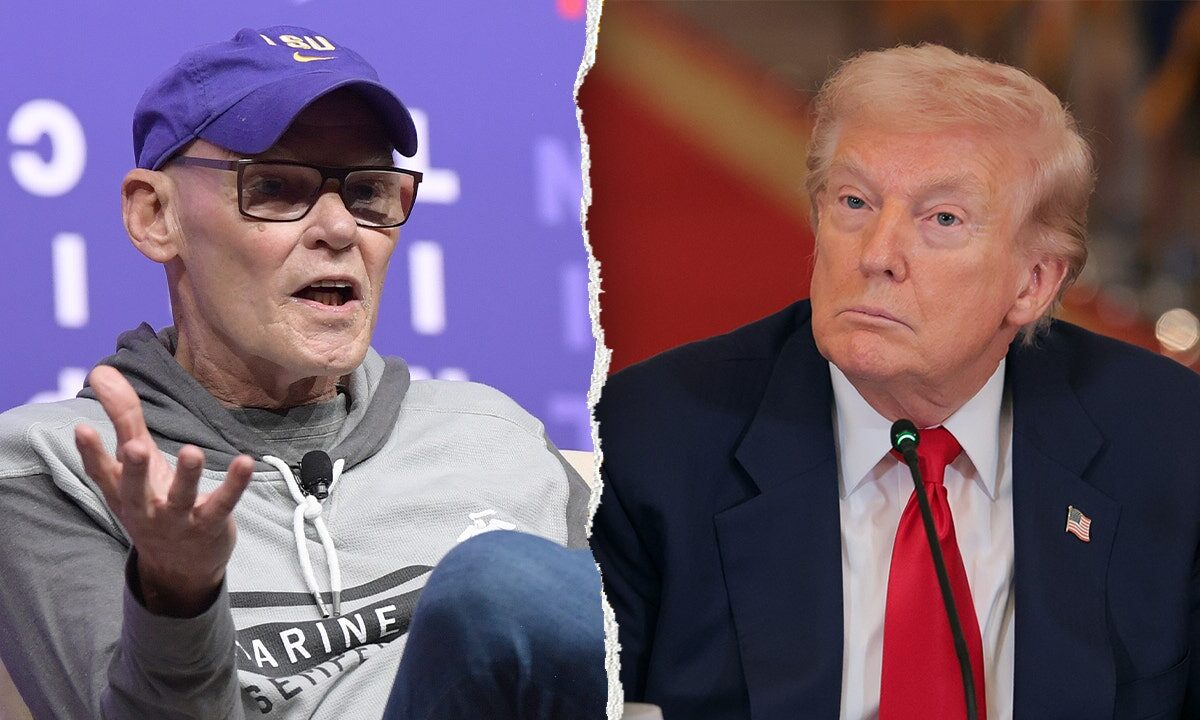
“How did Trump win? I’ll tell you how. Because god—n Bernie Sanders is the reason that Donald Trump is president.” That is the blunt charge James Carville opened with on camera, according to Fox News Digital, setting the tone for a combative critique of Bernie Sanders and the party’s leftward insurgents.
Carville’s remarks portray the rise of Democratic socialists as more than a policy dispute: he framed it as a strategic choice with electoral consequences. Fox News Digital reported the remarks and noted their profanity and sharp personal attacks.
James Carville on Bernie Sanders and 2016
Carville called the 2016 result “the most catastrophic political event of this century,” saying Sanders’ insurgency helped convince working‑class voters that the party was not on their side, which he argued contributed to Donald Trump winning key swing states. That characterization — Carville’s own assessment as reported by Fox News Digital — links intraparty insurgency to general‑election outcomes.
He argued Sanders’ critique of Hillary Clinton and the party establishment changed perceptions in Pennsylvania, Michigan and Wisconsin, shifting narrow margins. Carville presented this as a causal chain; analysts interviewed after 2016 have debated how much any single factor changed the outcome.
Carville on democratic socialists and party schism
Beyond assigning blame, Carville urged a structural response: a schism within the Democratic Party that would limit the influence of Democratic socialists. He used the phrase “useful idiots” for some insurgent figures, according to the Fox News account, and argued they should focus first on beating Republicans before targeting establishment Democrats.
That prescription revives a longstanding internal debate: prioritize ideological purity and long‑term movement goals, or prioritize short‑term electability and coalition maintenance. Carville’s answer is explicit and uncompromising — electoral pragmatism first.
Reactions and immediate sourcing
Fox News Digital reported it reached out to Sen. Bernie Sanders for comment and did not immediately receive a response. The outlet also highlighted the insulting language Carville used and labeled some of his causal claims counterfactual — disputable assessments about what would have happened under different circumstances.
Commentators and party operatives reacted quickly. Some Democrats and progressive commentators pushed back, saying Carville overstates the effect of intra‑party tensions and ignores other documented factors in 2016 such as late‑breaking news events and foreign interference, which many analysts cite as additional contributors to the result.
Other veteran strategists echoed parts of Carville’s warning: that primary upsets producing nominees perceived as weak in swing states can harm general‑election prospects. Those voices tend to stress candidate vetting, targeted messaging in the Rust Belt and investment in ground operations.
What this means for Democratic strategy
Carville’s intervention is tactical as much as rhetorical. If party leaders accept his thesis, they may push for more active intervention in primaries, tighter candidate vetting and messaging discipline in general‑election battlegrounds.
That approach risks alienating progressives who argue that structural reforms (expanding turnout, addressing economic inequality, and reshaping party rules) are the path to long‑term success. The tension is practical: short‑term ballot victories versus long‑term party transformation.
Practical implications include how the Democratic National Committee and state parties allocate resources, whether national groups endorse in primaries, and how operatives prioritize swing voters versus base mobilization. Carville frames those choices as existential: losing ground in a handful of states can cost the White House.
Background on Carville and the 2016 debate
James Carville rose to prominence as the lead strategist in Bill Clinton’s 1992 campaign and has long been a public voice for electoral pragmatism. His standing in Democratic circles comes from decades of campaign experience and a focus on coalition building.
The 2016 Democratic primary between Hillary Clinton and Bernie Sanders exposed deep ideological divisions that followed into the general election. Scholars and pollsters continue to analyze the mix of causes for Trump’s victory; Carville’s comments repurpose that debate as a lesson for present‑day strategy.
What comes next
Expect a conversational tug‑of‑war. Carville’s remarks will be used by allies of a centrist corrective and echoed by critics who see his remarks as an attempt to silence internal dissent. Practically, the speech may shape donor behavior, endorsement decisions and how national groups deploy staff in competitive primary contests.
Whether Carville’s prescription leads to formal rule changes, sanctioned primaries or coordinated endorsements remains uncertain. For now, his intervention is a provocation: it sharpens questions about party unity, primary authority and the tradeoffs between principle and electability.
Read the original Fox News coverage for the full transcript and context: Fox News: James Carville blames Bernie Sanders for Trump being president in fiery rant.
Source: Fox News Digital.