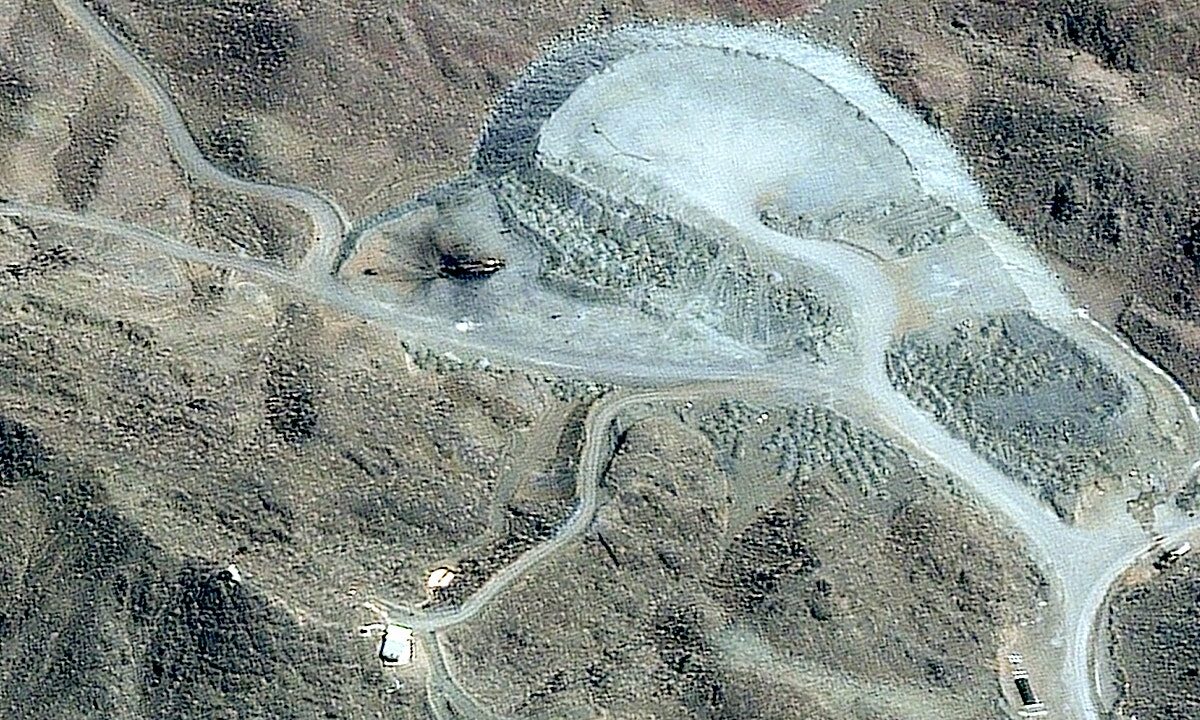
Late‑June commercial satellite imagery, analyzed by the Institute for Science and International Security (ISIS), shows ongoing construction and vehicle movement at Pickaxe Mountain, an underground complex in Iran’s Zagros range. ISIS says activity at western tunnel portals continued through late June 2026; IAEA inspectors have not been granted access.
Quick summary
ISIS published an analysis of late‑June imagery documenting vehicle traffic on roads up to Pickaxe Mountain’s western tunnel portals and signs of hardening at entrances. The International Atomic Energy Agency (IAEA) has not been permitted to inspect the site, which limits the agency’s ability to independently verify what is happening underground.
What the satellite images show at Pickaxe Mountain
ISIS analysts write that commercially available satellite images from late June 2026 show persistent vehicle movement on access roads leading to the western portals of Pickaxe Mountain and visual indicators of work to clear and harden entrance areas.
Specific observations cited by ISIS include cleared and widened access routes, regular vehicle presence near portal zones, and disturbed ground near tunnel mouths consistent with excavation or internal tunnel work. ISIS compares the late‑June imagery with imagery from previous years to argue the pattern has been sustained since at least 2020.
ISIS frames these observations as analysis and inference from surface indicators; the group notes that surface signs can suggest internal changes but cannot by themselves confirm installed equipment or nuclear activities.
IAEA access and verification limits
ISIS and subsequent reporting note that IAEA inspectors have not been allowed to visit Pickaxe Mountain. The IAEA has repeatedly emphasized that its safeguards conclusions are based on the evaluation of all safeguards‑relevant information available to the Agency, including on‑site inspections when access is provided. Without such access, the IAEA’s ability to corroborate imagery‑based assessments is constrained.
In practical terms, remote sensing increases uncertainty: surface construction can be documented, but whether sites are being prepared for a particular nuclear function — such as enrichment — cannot be confirmed without physical access, environmental sampling, and direct inspections.
How Pickaxe Mountain fits the Iran nuclear picture
ISIS placed Pickaxe Mountain in relation to Iran’s known underground nuclear complexes. The group reported limited observable activity at Natanz in late June 2026, including damaged access points to some below‑ground halls that appear unrepaired. At Esfahan (Isfahan), ISIS reported no observed activity as of June 29, 2026, noting some tunnel portals appear backfilled. Fordow showed signs of reinforced access routes and the placement of engineered mounds along approach roads — passive measures ISIS describes as slowing vehicle movement.
ISIS also wrote that, based on surface dimensions and tunnel estimates, Pickaxe Mountain could be large enough to host enrichment operations, but it explicitly cautioned that such a conclusion cannot be independently confirmed from imagery alone.
Expert reaction and diplomatic implications
Spencer Faragasso, a senior fellow at ISIS, described the pattern of work at Pickaxe Mountain as “deeply concerning” and called it a possible hedge in the event negotiations falter. Faragasso wrote that halting construction and permitting IAEA access would be a tangible signal of good faith under the existing memorandum of understanding (MOU) framework.
On the MOU: parties have described the agreement as aimed at maintaining a status quo at nuclear‑related locations while diplomacy proceeds. Terms and specific enforcement mechanisms for preserving that status quo vary by diplomatic text and are often not fully public; it is therefore unclear how any violations would be addressed in practice beyond diplomatic pressure and requests for IAEA access.
Analysts say likely next steps include pressing Iranian authorities for IAEA access to Pickaxe Mountain, acquiring additional imagery over time to corroborate trends, and sequencing diplomatic measures so verification can progress without unnecessary escalation.
Conclusion
ISIS’s imagery‑based analysis points to ongoing surface activity at Pickaxe Mountain through late June 2026 and raises questions about potential underground work. But because the IAEA has not been allowed on site, independent confirmation of internal functions is not currently possible. Verification will depend on gaining IAEA access, additional corroborating imagery, and careful diplomatic engagement to clarify the site’s status under any applicable MOU.
“If Iran is serious about negotiating, it should halt construction at Pickaxe Mountain as a token of good faith,” Spencer Faragasso wrote in ISIS’s assessment, while analysts stress that a definitive judgement requires on‑the‑ground verification.
Source attribution: This article is based on the Institute for Science and International Security’s satellite analysis and reporting by Fox News. See the ISIS analysis (as posted by the authors) and the Fox News write‑up linked below for the original imagery comparisons and ISIS commentary. For IAEA safeguards guidance and the agency’s description of verification limits, see the IAEA’s public materials.
Links: Fox News — Experts say ‘deeply’ concerned over Iran’s work at underground nuclear site
ISIS analysis (original source referenced by reporting): https://isis-online.org/ (Institute for Science and International Security analysis referenced in reporting)
IAEA safeguards overview: iaea.org