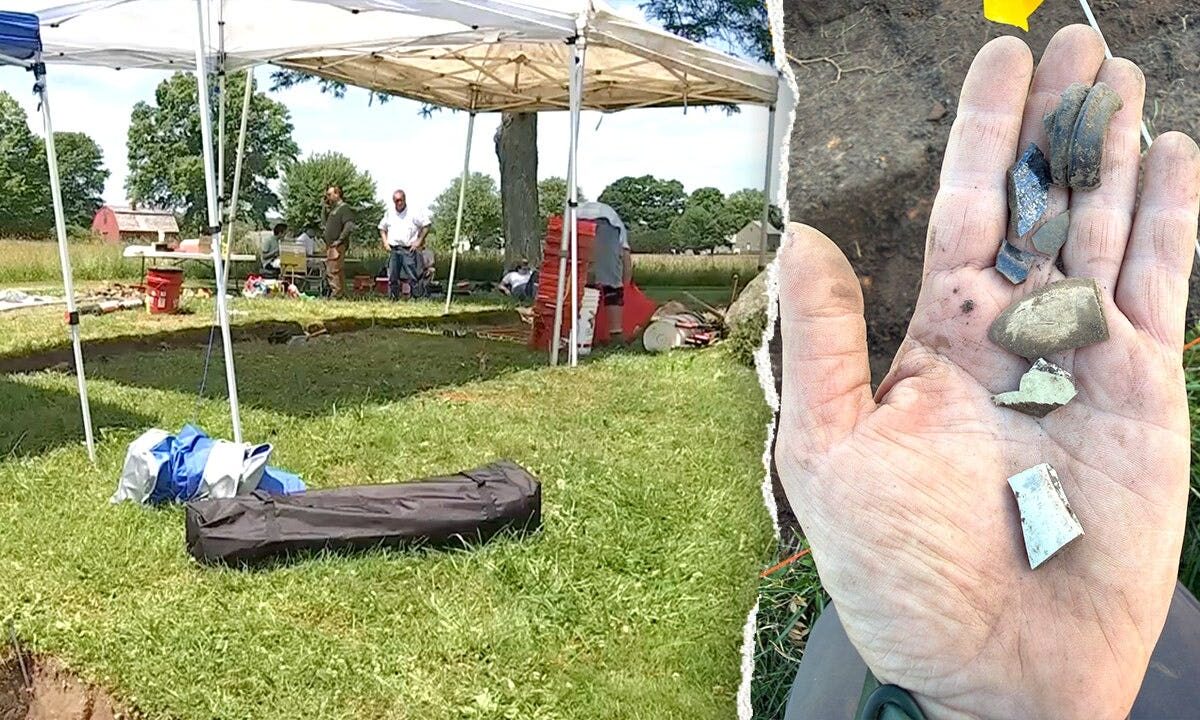
Archaeologists working on Lebanon Town Green say they have exposed the remains of a Revolutionary War bake house, a rare structural survival tied to a French encampment in Lebanon, Connecticut. The discovery — an intact stone-and-brick foundation filled with rubble — appeared during early June excavations and has prompted plans for additional fieldwork this fall to confirm date and function.
Revolutionary War bake house: What was uncovered on Lebanon Town Green
The exposed feature appears as a semi-permanent masonry structure: a low stone base with surviving brickwork where a baking chamber or oven would have stood. Photographs taken at the dig show a rectangular foundation cut into the subsoil, with a yard of stone rubble filling much of the interior and intact courses of brick lining a probable oven area.
Field crews documented the layout carefully, measured the foundation plan, and recorded stratigraphic sections to separate later landscaping fills from 18th-century deposits. Topsoil and modern fill were removed to reveal deeper layers that contained ceramic and glass fragments consistent with late-1700s occupation.
Why researchers call it a Revolutionary War bake house
Investigators say the form and materials fit historical descriptions of semi-permanent bake ovens used to supply bread to soldiers during campaigns. The feature lies within an area long associated with an encampment along the route used by French troops under General Rochambeau during the Revolutionary War, a context that informs the interpretation.
Project leaders point to subsurface survey results as corroborating evidence. “A ground-penetrating radar survey carried out prior to the dig indicates that the stone and brick structure we excavated was part of a possible complex of structures in this part of the green,” Sarah P. Sportman, Connecticut state archaeologist, told Fox News Digital.
That combination of documentary expectation, structure type and GPR anomalies makes the bake-house interpretation plausible. Archaeologists emphasize this remains a working conclusion until additional testing can confirm associated features and secure datable materials.
What the artifacts and layers reveal
Material remains recovered so far are relatively sparse, a pattern the state archaeologist described as expected for short-term military encampments that left limited household refuse. The uppermost fills produced late-19th-century ceramic and glass fragments consistent with later landscaping and yard work.
Deeper contexts yielded a small suite of late-18th-century items: ceramic sherds, fragments of clay tobacco pipes, small bone fragments and older bottle glass. On the final day of the field program crews recovered a burned gunflint — a small but suggestive artifact given its routine use with flintlock firearms of the Revolutionary era.
“Gunflints were chipped pieces of stone used in flintlock firearms,” Sportman told Fox News Digital, describing the find’s potential relevance. She added that “overall, though, the number of artifacts was quite low,” underscoring the need for cautious interpretation.
Modern notes from the dig also document an 1896 amateur excavation on the green that reportedly exposed masonry and bricks but left no mapped context or photographs. Because earlier disturbances can complicate readings of the site, teams emphasize stratigraphic recording and careful sample collection to separate 19th-century disturbance from 18th-century features.
Next steps and why this matters
Researchers plan additional testing in the fall to clarify features surrounding the oven, refine the site’s stratigraphy and seek datable materials that can tie the structure more firmly to a Revolutionary War occupation. Sportman said the team hopes further work “will clarify some of those features and help us better understand the site.”
Planned work will emphasize controlled test units, targeted sampling for charred organic remains or other datable materials, and expanded geophysical mapping to define neighboring anomalies. Laboratory analysis of recovered artifacts and materials will be central to establishing a secure chronology and functional interpretation.
Beyond dating and function, the discovery contributes to a broader understanding of New London County’s role in the war. Nearby sites have been identified that may relate to militia activity and allied logistics; if fall testing confirms a military bake house, the feature would be a rare, built example of the food-production infrastructure that supported allied armies on the move.
Archaeologists stress caution: the identification of the structure as a bake house and its association with French troops are interpretations built from current evidence and context rather than established fact. Additional excavation, laboratory dating and documentary research will be necessary to confirm the site’s full story.
Source: Fox News — Hidden Revolutionary War bake house is uncovered after spending centuries underground