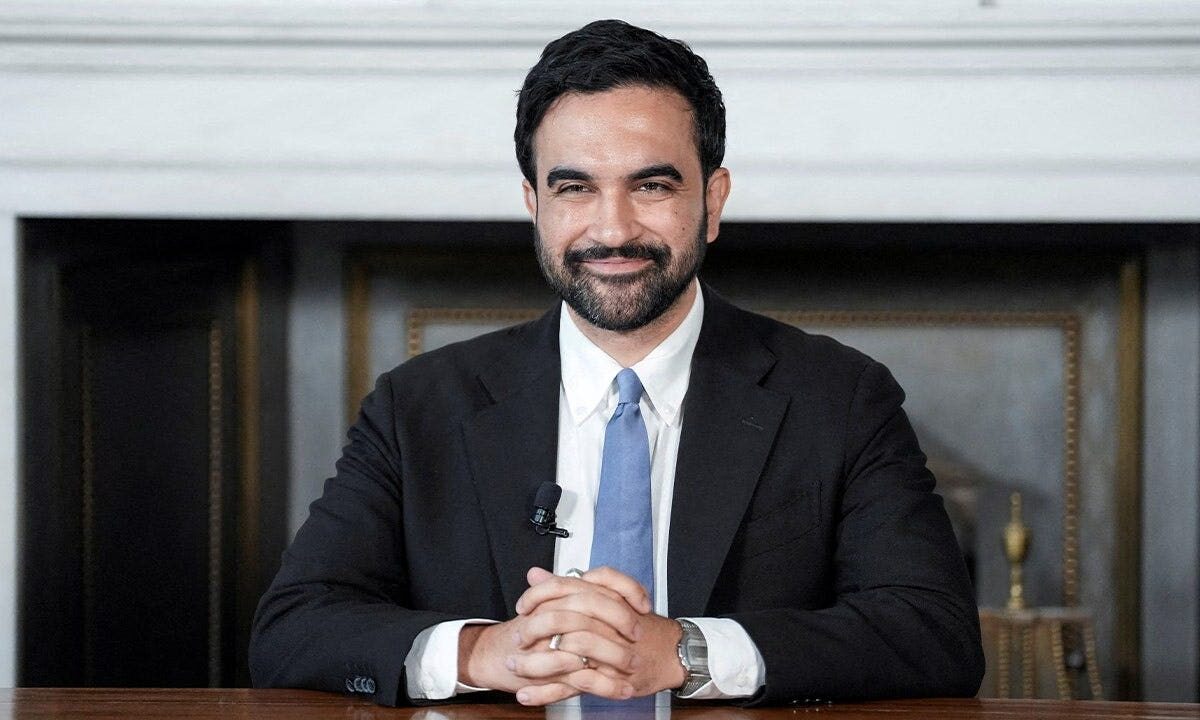
Zohran Mamdani opened a recent interview by arguing that Democratic Socialism is a contemporary return to the Democratic Party’s New Deal roots — and he used that framing to reassure business leaders that his administration still values private investment.
“So much of what makes me proud to be a Democrat is looking at what our party used to stand for. You think about the Four Freedoms, you think FDR, you think the New Deal,” Mamdani told The New York Times. He added that while he supports raising taxes on the city’s wealthiest residents, he expects to work with finance and real estate leaders to keep the city competitive.
Zohran Mamdani on democratic socialism and business ties
Mamdani framed Democratic Socialism less as a break with traditional Democratic economic policy than as a revival of older priorities: public investment, broader access to services and a stronger social safety net. He said those aims do not rule out collaboration with private firms.
“What I have in common with leaders of those sectors — even amid disagreements, because I believe that we can raise taxes a little bit more on the wealthiest New Yorkers — what brings us together is both a belief in the city and a commitment to its continued vitality,” he said in the interview. He stressed that policy choices should be presented as investments in the city, not simple demands on businesses.
Mamdani pointed to corporate commitments such as American Express’ decision to locate at Two World Trade Center as examples that companies still see strategic value in New York. He argued that decisions by firms reflect a mix of long-term market considerations, workforce access and the city’s global role — not only short-term tax comparisons.
Tax plan and the millionaire decline
Taxation on high earners is central to Mamdani’s fiscal vision. He has said increasing contributions from the wealthiest residents would fund expanded services and economic opportunity. Those proposals are intended to finance schools, transit and other city priorities that supporters say underpin a healthy business environment.
But an analysis by the Citizens Budget Commission (CBC) complicates the calculus. The CBC found New York’s share of the nation’s millionaires dropped from 12.7% in 2010 to 8.7% in 2022 — the steepest decline among states — and estimated a $10.7 billion shortfall in personal income tax revenue for 2022 alone. The report cites factors such as high taxes and stronger growth in Sun Belt states as contributors, while noting that migration, housing costs and broader economic shifts also play roles.
The CBC findings underscore a policy trade-off: higher marginal rates may raise revenue per taxpayer but could also influence where top earners choose to live and work. Policymakers must weigh those dynamics when sketching concrete proposals and revenue projections.
Business response and evidence of investment
Mamdani has sought to show that corporate leaders can accept a more progressive tax stance while still committing capital to the city. He repeatedly used the American Express move to Two World Trade Center as an example of investment that continued despite a pitched national debate over tax competitiveness.
Business leaders and city officials describe a mix of pragmatism and guarded optimism. Several executives, speaking in public forums, say they will cooperate with an administration that preserves regulatory clarity and invests in infrastructure and the workforce. Others caution that tax policy, regulatory costs and macroeconomic trends will shape adoption of future projects.
In private discussions and public statements, corporate representatives emphasize predictability. For many firms, the calculus includes long-term access to talent, stable regulation, and quality public services. Mamdani’s pitch is to marry those assurances with a stronger social compact funded in part by higher contributions from the wealthy.
Why this matters for New York and the Democratic Party
Locally, the stakes are fiscal health and competitiveness. Tax and spending choices affect revenue streams for public schools, transit, housing and social programs. They also influence where professionals and corporations locate their headquarters and offices.
Nationally, Mamdani’s profile arrives amid broader Democratic Party debates about economic strategy ahead of the 2028 election. His effort to recast Democratic Socialism as a New Deal-style approach contributes to the party’s conversation about whether to emphasize redistribution, investment, or a blend of both. That framing may influence messaging and policy development among Democrats across jurisdictions.
What comes next
Expect Mamdani’s administration to move from broad commitments to detailed proposals. That will include budgetary estimates, modeled revenue scenarios and negotiations with the City Council. Any plan to raise taxes on millionaires or corporations will require legal and fiscal review, projected revenue tallies, and outreach to build political support.
The process will likely include public hearings, revenue forecasts from city fiscal offices, and engagement with business leaders to identify offsets — such as targeted incentives, workforce investments, or regulatory changes — that could reduce the risk of out-migration or deterred investment. The administration will need to balance revenue goals with messaging designed to keep private investment engaged.
FAQ
What does Zohran Mamdani mean by democratic socialism?
Mamdani describes Democratic Socialism as a policy orientation that prioritizes public investment, expanded services and measures aimed at shared prosperity. He frames it as a return to New Deal-style priorities rather than a call to eliminate private enterprise.
Will Mamdani raise taxes on millionaires in New York?
He has prioritized asking wealthier residents and corporations to contribute more. Specific proposals would move through the city’s budget process, require fiscal modeling and face political negotiation; timing and exact measures remain to be determined.
Does corporate investment mean businesses back his tax plans?
Not necessarily. Mamdani notes continued investment by firms like American Express as evidence companies still see value in New York. But investment decisions reflect many factors. Businesses may still press for stability, incentives and workforce development, even if they do not publicly endorse higher taxes.
Source attribution
This article draws on reporting by Fox News, a New York Times interview with Zohran Mamdani, and analysis from the Citizens Budget Commission.
Original reporting: Fox News; interview cited: The New York Times; analysis cited: Citizens Budget Commission.