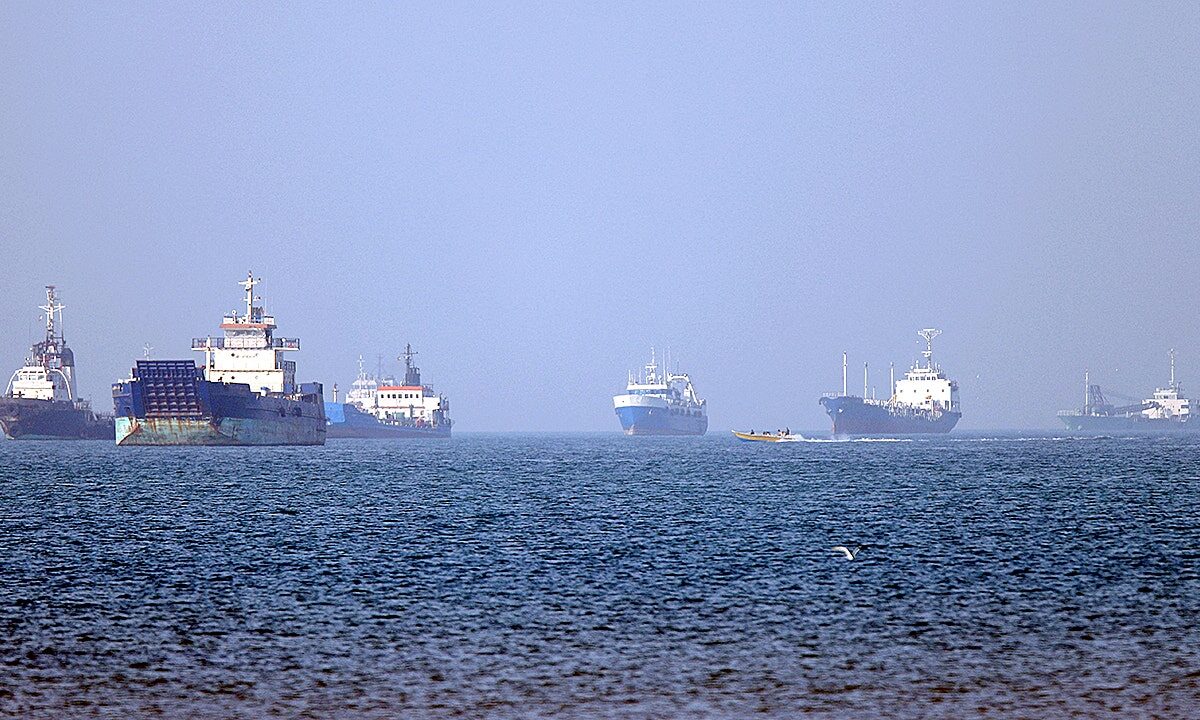
Kharg Island resumed large-scale export activity this week, building a queue of roughly 28 tankers and prompting renewed scrutiny of transit through the Strait of Hormuz. Windward AI reported the Kharg East Waiting Area held 28 tankers, 27 of them listed as dark, while analytics firm Vortexa estimated about 4.12 million barrels of wet cargo outbound (roughly 3.91 million barrels of crude). Hapag-Lloyd has described operations in the region as “for some months the new normal in the Persian Gulf region,” underscoring why carriers and shippers are treating voyages through the strait with heightened caution.
The restart at Kharg — simultaneous loading at multiple terminals and dense offshore concentrations — is already reshaping operational choices for container lines and crude carriers transiting the Persian Gulf. Vessels and their insurers are increasingly evaluating each transit on a case-by-case basis, factoring in potential route closures, insurance exposure and crew safety before committing to passages through the strait.
What happened at Kharg Island
Maritime monitoring firms said Kharg’s T-Jetty and Western Terminal loaded nearly simultaneously after days of limited movement. Windward AI specifically flagged the East Waiting Area as holding 28 tankers with 27 listed as dark, an indicator firms use to signal risk-avoidance or attempts to obscure position data.
Vortexa’s cargo tally placed total outbound wet cargo at roughly 4.12 million barrels, of which about 3.91 million barrels were classified as crude — figures that point to a sizable restart in Iranian export flows compared with the constrained pace seen in recent weeks. The confluence of large volume and dense vessel clustering increases operational friction: ports and terminals face concentrated demand while ships offshore can experience delays, stacking and additional security concerns.
Dark tonnage and simultaneous terminal operations matter because they combine supply-side decisions to move product with buyer and shipper decisions to minimize exposure. Analysts say this pattern can temporarily amplify local bottlenecks and complicate destination planning for refiners and traders.
Strait of Hormuz: shipping response
Hapag-Lloyd has told carriers and customers it is treating the region’s situation as a prolonged change in baseline risk, stressing that “the safety of our crews is our highest priority.” The company confirmed that vessels affected by a recent temporary closure were able to depart the Persian Gulf and that it continues “regular risk and situation assessments with our security partners, all relevant authorities and our people on shore and, of course, on the vessels.”
Operational responses across the industry include delayed sailings, revised voyage plans where feasible, increased use of security advisers and closer coordination with naval forces and insurers. Carriers are also working more closely with private maritime security contractors and national navies to monitor transit corridors and keep crews informed of evolving advisories.
Those choices carry commercial consequences: rerouting can add days to voyages and raise fuel and charter costs, and temporary hold or waiting times offshore can create demurrage exposure. Insurers and charterers are updating voyage risk profiles in real time, which in turn affects cover terms and premiums for passages involving the Strait of Hormuz.
Who controls routes and recent strikes
Industry reporting, including coverage by Lloyd’s List, describes a fragmented two-tier routing picture in the Persian Gulf: a northern lane effectively under Iranian control and a southern corridor operating with U.S.-led protection. That fracture in practical route authority forces vessels to choose lanes based on threat assessments, naval presence and the guidance of security advisors (Lloyd’s List).
The security environment has been intensified by kinetic actions. U.S. Central Command (CENTCOM) reported airstrikes on June 26 against Iranian-linked targets, including positions on Qeshm Island, after attacks in the area. Iranian paramilitary forces reportedly conducted retaliatory strikes that were directed at facilities in Kuwait and Bahrain. Iranian officials, including Foreign Minister Abbas Araghchi, have said Tehran views itself as responsible for reopening and managing maritime traffic under recent understandings, a stance that sits alongside competing coalition advisories.
Impact on crude flows and maritime routing
Split or contested routing directly affects crude oil shipments. When commonly used lanes are judged unsafe because of mines, strikes or other threats, tankers face a trade-off: longer detours that increase voyage time and cost, or concentrated corridors that reduce available capacity and raise the chance of waiting-area queues. Vortexa’s figure that roughly 4.12 million barrels were staged at Kharg illustrates how a single export hub can drive short-term vessel density and market signals.
Concentrations of outgoing cargo increase the probability that vessels will cluster, await berth or even switch off AIS transponders to limit visibility — all of which complicate booking, scheduling and cargo allocation for refiners and traders. That uncertainty can ripple into temporary price and logistics volatility for crude originating from the Persian Gulf, and into operational headaches for charterers and terminal operators.
For shippers reliant on timely crude flows, the immediate implications are scheduling uncertainty, the possibility of demurrage costs, and the need for contingency plans that account for variable transit times and added security expenditures.
What comes next for shipping and security
Operators, insurers and naval forces are expected to keep close watch on the situation. Shipping companies say they will continue to rely on enhanced risk assessments, consultations with security partners and coordination with relevant authorities when plotting voyages through or around the strait (Hapag-Lloyd).
Potential escalation paths include further strikes or retaliatory actions that could intermittently close lanes or force longer routings. Conversely, diplomatic engagement or localized de-escalation measures could allow more predictable operations to resume. In the near term, carriers should expect irregular transit speeds, potential additional costs for security measures, and ongoing modifications to transit advisories.
Commercial actors and regional navies will likely keep treating each voyage as an individual security calculus rather than assuming a return to pre-conflict norms. Continued public reporting from maritime intelligence firms such as Windward AI and Vortexa will remain a key input into operational decision-making.
By the numbers
- 28 tankers in the Kharg East Waiting Area, 27 listed as dark (Windward AI).
- 4.12 million barrels of wet cargo estimated outbound from Kharg; ~3.91 million barrels crude (Vortexa).
- June 26: CENTCOM reported airstrikes against targets including Qeshm Island.
FAQ
What happened with Strait of Hormuz?
Kharg Island resumed large-scale loading, producing a sizable queue of tankers offshore and prompting renewed caution about transits through the Strait of Hormuz. That movement, combined with recent strikes and overlapping maritime guidance from different authorities, has fragmented route control and increased operational risk for vessels in the area.
Why does Strait of Hormuz matter?
The strait is a global chokepoint for crude oil and liquid hydrocarbons. Disruptions to normal transit patterns affect vessel routing, delivery schedules and energy market stability because many shipments must pass through the narrow corridor to reach international buyers.
What happens next?
Shipping companies and insurers will continue heightened monitoring and risk assessments with security partners and authorities. Expect intermittent route advisories, potential temporary closures or rerouting, and ongoing naval and diplomatic activity until more durable, low-tension transit arrangements are in place.
Sources: Reporting based on Fox News coverage (Fox News). Data and analysis cited from Windward AI, Vortexa, Hapag-Lloyd statements, U.S. Central Command (CENTCOM) reporting, and industry reporting including Lloyd’s List.