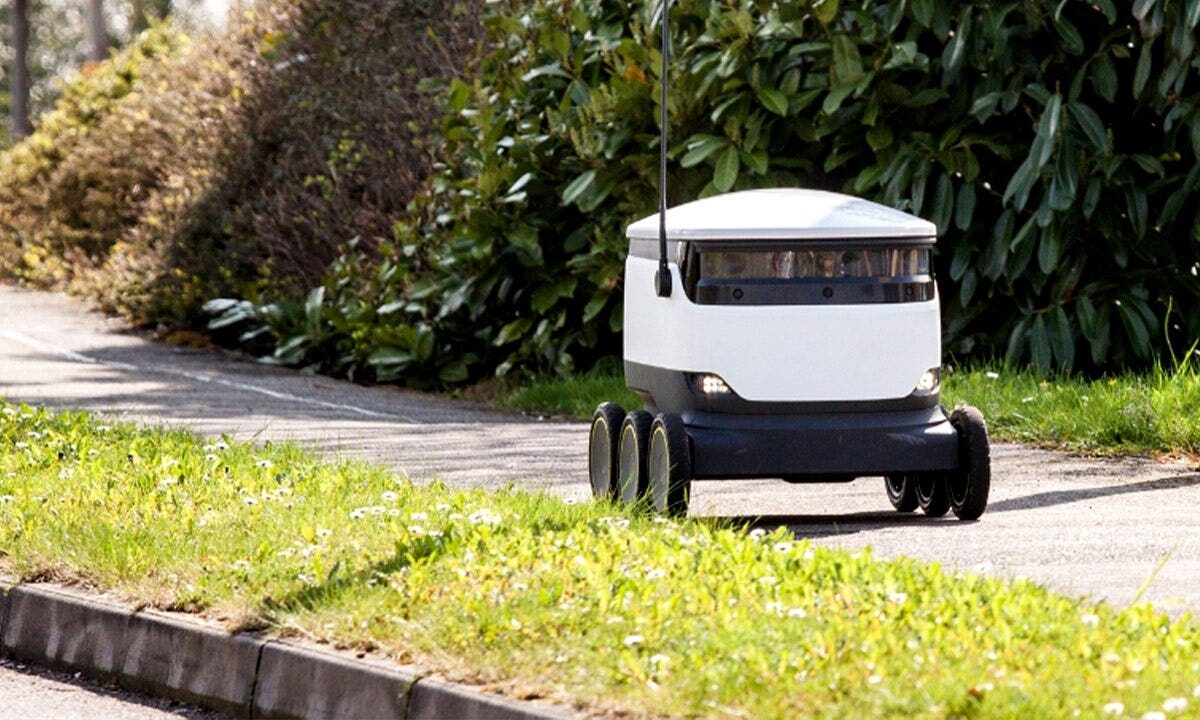
Starship Technologies announced it will wind down its U.S. university campus operations and redeploy more than 1,200 Starship delivery robots to grocery and hot-food delivery in cities across the U.S. and Europe.
What Starship announced
The company said it will scale back campus fleets in the U.S. and shift a significant portion of its autonomous sidewalk robots into grocery and restaurant delivery markets. Starship described the move as a strategic pivot, redeploying more than 1,200 robots from college walkways to urban delivery routes while maintaining transition plans for campuses.
Starship said it will coordinate staged transitions so campus deliveries remain available through the handover period, with coverage intended to continue into the 2026–2027 back-to-school season for affected schools. George Mason University — the first U.S. campus to use Starship robots in 2019 — is among the early partners that helped the company refine operations on controlled campus paths.
Starship delivery robots and the grocery push
Starship positions grocery delivery as the primary growth engine behind the change. The company says its grocery business is on a “10x growth trajectory” over the next two years and points to markets such as Finland — where it reports a larger share of grocery deliveries — as evidence that the model can scale beyond campus environments.
Starship executives also have said the robots can lower per-delivery costs by roughly $3–$4 compared with some traditional courier models, a figure the company uses when marketing to retail partners. The company has highlighted its cumulative experience — reporting over 10 million deliveries globally — to argue the platform is operationally mature enough to take on heavier, more varied grocery orders.
Delivering groceries presents technical and operational challenges that differ from campus food runs: orders are heavier, item handling and temperature control matter, and customer expectations for timeliness and accuracy can be higher. Starship says it is working with retailers to integrate order flows, bagging and pickup processes so robots can move efficiently between stores and customers without excessive delays.
Safety, accessibility and local pushback
Putting robots onto busy city sidewalks raises practical concerns about pedestrian safety and access. Across multiple cities, reporters and local officials have documented incidents where delivery robots bumped into people, became stuck in tight spots, or created obstacles for people using wheelchairs, canes or strollers.
Chicago is among the municipalities that have seen local pushback and complaints related to sidewalk delivery vehicles. In Chicago, residents and some local advocates have reported robots interfering with pedestrian flow near storefronts and crowded crosswalks, sparking calls for clearer municipal rules on where and how such devices may operate.
Advocates and city officials stress that robots must not obstruct curb ramps, bus stops or key pedestrian pathways. Starship relies on sensors, cameras and on-device navigation to avoid collisions; privacy advocates and some city agencies want more detailed disclosures about what data the robots collect, retention timelines and circumstances for sharing footage with law enforcement or third parties.
How the shift affects campuses and cities
For campuses, the redeployment ends a testing chapter that began when schools like George Mason partnered with Starship to trial contactless delivery on relatively predictable routes. Students accustomed to convenient robot deliveries may see services replaced by different delivery options, or experience phased reductions as machines move to urban grocery assignments.
On the city side, the change will be gradual. Starship says it plans staged rollouts and retailer integrations so robots are reconfigured for heavier grocery loads, different pickup locations and more complex curb interactions. Success will hinge on retailer participation, municipal permitting, and the robots’ ability to operate reliably amid high pedestrian density.
The company frames the move as part of a broader last-mile delivery strategy that could reduce short car trips for nearby orders and lower costs for retailers. However, whether robots achieve sustained operational reliability at scale will depend on real-world testing, municipal rules and consumer acceptance.
Many of the operational figures Starship cites — including the 10x grocery growth projection, the $3–$4 per-delivery cost savings estimate, and the reported total deliveries completed — are provided by the company as part of its public statements.
Starship was founded in Tallinn, Estonia, in 2014 by Ahti Heinla and Janus Friis, and the company notes it maintains core engineering and AI teams there while operating fleets across multiple countries.
Starship’s claims about growth trajectory, cost-savings and delivery-share are self-reported by Starship Technologies and have not been independently verified; those company-reported figures are described by the company in public statements (source: Starship Technologies).
Source: Fox News.