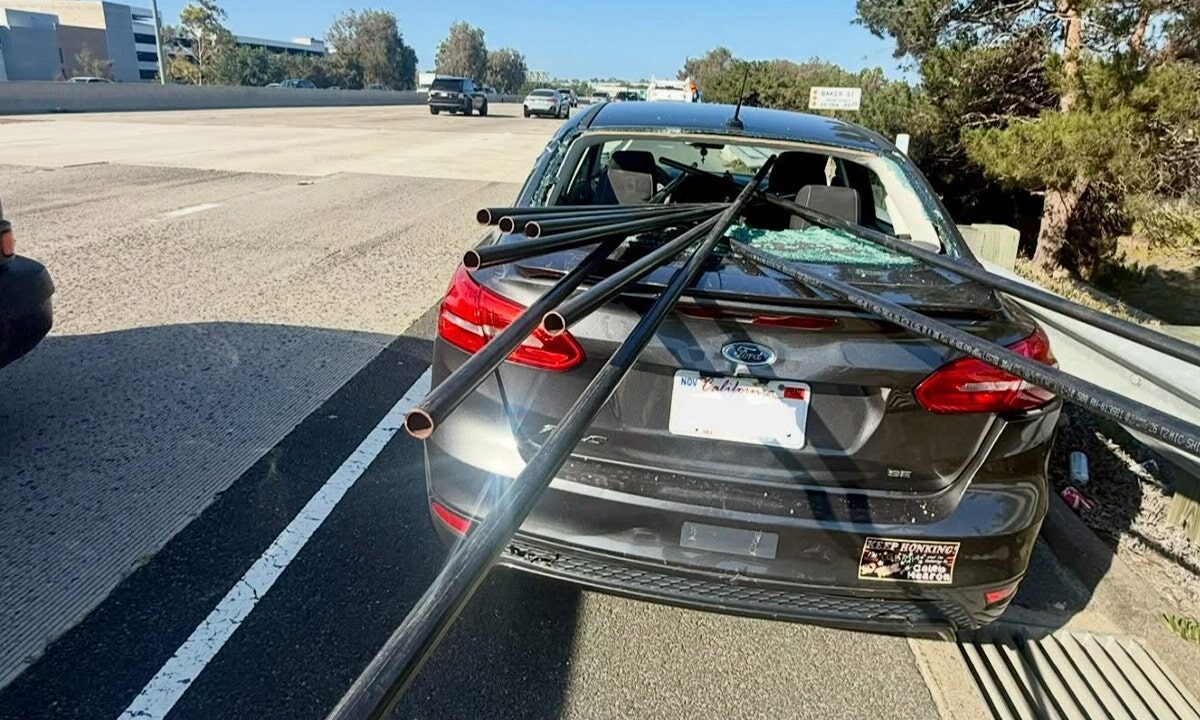
The California Highway Patrol released dramatic photos showing at least six unsecured metal pipes driven through the rear windshield of a gray sedan after a two-vehicle crash on an Orange County highway. The CHP said the pipes were loaded on a white pickup and, after the initial impact, were propelled forward into the sedan; the sedan driver escaped with only minor injuries, the agency reported.
The CHP Santa Ana Area Office provided the images and an official statement on Thursday, using the photos to warn motorists and commercial haulers across Orange County and Southern California about the everyday danger of unsecured cargo. CHP investigators emphasized that while the initial collision set the sequence in motion, it was the unsecured nature of the load that allowed the pipes to become dangerous projectiles.
Crash details from CHP
The California Highway Patrol said the two-vehicle crash involved a white pickup truck carrying long metal pipes and a gray sedan. According to the CHP Santa Ana Area Office, investigators determined the pickup struck the sedan and, after the contact, the unsecured metal pipes from the pickup were propelled forward and pierced the sedan’s rear window.
CHP investigators noted that photos show at least six pipes lodged through the shattered rear windshield; by the agency’s account, the sedan driver suffered only minor injuries and did not require hospitalization at the scene. “After the initial impact, the unsecured metal pipes from the pickup truck were propelled forward, into the sedan, and through the sedan’s rear window,” the CHP said in its statement.
How unsecured metal pipes caused the damage
Unsecured metal pipes become heavy, blunt projectiles in a collision because their mass and forward momentum are transferred out of the pickup bed and into whatever lies ahead. The CHP photos make the mechanics clear: the pipes penetrated the back of the sedan at an angle consistent with forward momentum, entering the rear passenger compartment and leaving significant structural damage.
CHP investigators explained the likely sequence: the striking force from the pickup moved the pipes along the bed toward the tailgate, and without proper tie-downs or bulkheads the pipes were able to break through or bypass the pickup’s rear restraint and continue forward into following traffic. The agency used the images to underscore how a routine construction or materials run can become deadly if loads are not secured.
Road debris risk and AAA data
The California Highway Patrol pointed to the crash as an example of a nationwide problem with loose cargo and road debris. The AAA Foundation for Traffic Safety analyzed debris-related incidents and reported that road debris contributed to roughly 53,000 crashes annually between 2018 and 2023, the AAA Foundation said. Over that span the foundation found those crashes averaged about 5,500 injuries and 72 deaths per year.
“Unsecured cargo causes crashes every year, leading to hundreds of deaths and thousands of injuries nationwide,” CHP officials warned in their statement, according to the Santa Ana Area Office. The agency asked drivers and contractors to heed the message, especially in high-traffic parts of Orange County and other Southern California corridors where secondary collisions are more likely.
While the CHP did not identify a specific freeway in its release, Orange County is served by several busy corridors— including the I-5, I-405 and SR-55—where commuter congestion and higher speeds can raise the risk that flying or falling cargo will trigger additional collisions or cause serious injuries to motorists and passengers.
Safety steps for haulers and drivers
When a load isn’t properly secured, everyone on the road is at risk. Both the CHP and national safety experts recommend practical steps to reduce that risk:
- Use tie-downs rated for the cargo: ratchet straps, heavy-duty ropes or cargo nets that match the weight and length of materials being transported.
- Install or use bulkheads and headache racks to prevent long items from sliding forward into the cab or out of the bed.
- Cover loose materials with tarps and secure the tarps so wind can’t catch and dislodge them during travel.
- Distribute weight evenly and avoid overhanging loads when possible; when overhang is unavoidable, use flags and proper markings per local rules.
- Inspect straps, anchors and knots before leaving and re-check them after a short distance; straps can shift during the first few miles of a trip.
- If you encounter debris in the roadway, slow and move over when safe, avoid abrupt swerves that cause loss of control, and report large hazards to law enforcement or highway agencies.
These steps reflect CHP guidance and best practices emphasized by safety organizations such as the AAA Foundation for Traffic Safety, which documents the frequency and seriousness of debris-related crashes.
Key takeaways for Southern California drivers
The Orange County incident illustrates two regional realities: seemingly secure loads can fail in a crash, and the consequences often extend beyond the vehicles directly involved. Short checks of straps, tarps and anchors can prevent serious outcomes. CHP asks anyone who hauls long or heavy materials to assume that a crash could send items forward and to secure loads accordingly.
CHP officials hope the graphic images and the agency’s statement serve as a timely reminder for contractors, tradespeople, landscapers and residents who transport pipes, lumber, metal and other potential road hazards across Southern California.
Source attribution: This report relies on statements and images from the California Highway Patrol Santa Ana Area Office and reporting by Fox News. Additional national road-debris data cited are from the AAA Foundation for Traffic Safety. Original reporting: Fox News — Unsecured metal pipes impale California sedan in terrifying highway crash.